Question
As the mass number A increases, the binding energy per nucleon in a nucleus:

Answer

  1.  Varies in a way that depends on the actual value of A.
Explanation:
Binding energy per nucleon in a nucleus first increases with increasing mass number (A) and reaches a maximum of 8.7MeV for A (50 - 80). Then, again it slowly starts decreasing with the increase in A and drops to the value of 7.5MeV.

Need a full question paper?

Generate a complete, print-ready paper with questions like this in minutes — across 16+ boards, with answer keys.
Start Generating Free

Similar questions

Solve the previous question if the closed loop is completely enclosed in the circuit containing the switch.
  1. An anticlockwise current-pulse.
  2. A clockwise current-pulse.
  3. An anticlockwise current-pulse and then a clockwise current-pulse.
  4. A clockwise current-pulse and then an anticlockwise current-pulse.
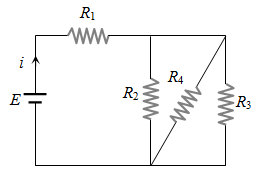
In the circuit given $E = 6.0 V, R_1 = 100\ ohms, R_2 = R_3 = 50\ ohms, R_4 = 75\ ohms$. The equivalent resistance of the circuit, in $ohms,$ is
What is the purpose of anode in a Cathode ray tube?
$CO_2$ gas is found in which of the following pairs of the planet
The current flowing in a copper voltameter is $1.6 A .$ The number of $\mathrm{Cu}^{++}$ ions deposited at the cathode per minute are
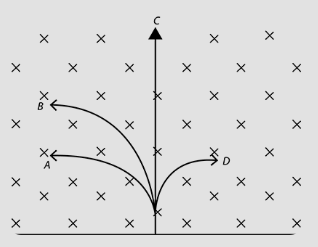
A neutron, a proton, an electron and an α−particle enter a region of uniform magnetic field with equal velocities. The magnetic field is perpendicular to the plane of paper and directed into it. The tracks of particles are labeled in the figure. The neutron follows the track:
The element which was observed in solar spectrum is:
A NPN transistor conducts when(a) Both collector and emitter are positive with respect to the base (b) Collector is positive and emitter is negative with respect to the base(c) Collector is positive and emitter is at same potential as the base(d) Both collector and emitter are negative with respect to the base


At constant potential difference, the resistance of any electric circuit is halved, the value of heat produced will be :
In an $LR-$circuit, time constant is that time in which current grows from zero to the value $($where $I _0$ is the steady state current$)$