MCQ
Assertion (A): A number when subtracted from 40 results into 15. This statement in the form of an equation is 40 - x = 15
Reason (R): Standard form for linear equation in one variable is ax + b = 0. where x is variable and a, b are arbitrary constants.
  • A
    Both A and R are true and R is the correct explanation of A
  • Both A and R are true but R is not the correct explanation of A
  • C
    A is true but R is false
  • D
    A is false but R is true

Answer

Correct option: B.
Both A and R are true but R is not the correct explanation of A
B

Need a full question paper?

Generate a complete, print-ready paper with questions like this in minutes — across 16+ boards, with answer keys.

Start Generating Free

Similar questions

Directions: In the following questions, the Assertions $(A)$ and Reason $(s)(R)$ have been put forward. Read both the statements carefully and choose the correct alternative from the following: Assertion $(A):$ The area of a rectangle of length $a$ and breadth $b$ is ab Reasons $(R):$ The area of a rectangle $(A)$ is the product of its length ' $a$ ' and width or breadth 'b'.
Directions: In the following questions, the Assertions $(A)$ and Reason$(s)$ $(R)$ have been put forward. Read both the statements carefully and choose the correct alternative from the following:
Assertion (A): The like terms are $ab, -5b$
Reasons (R): like terms are terms that have the same variables and powers
Directions : In the following questions, the Assertions $(A)$ and Reason $(s)\ (R)$ have been put forward. Read both the statements carefully and choose the correct alternative from the following:
Assertion $(A) :$ Rational numbers are commutative for multiplication
Reason $(R) :$ Rational numbers are commutative under addition and multiplication
Directions: In the following questions, the Assertions $(A)$ and Reason$(s)$ $(R)$ have been put forward. Read both the statements carefully and choose the correct alternative from the following:
Assertion $(A)$: The multiplicative inverse of am is $a^{-m}$
Reasons $(R)$: The multiplicative inverse of a number is defined as a number which when multiplied by the original number gives the product as $1.$
Directions: In the following questions, the Assertions $(A)$ and Reason(s) $(R)$ have been put forward. Read both the statements carefully and choose the correct alternative from the following: Observe the following histograma nd consider it as reasons for the following assertions:
Assertion (A): class intervals $15 - 20$ have the number of students $200$
Directions: In the following questions, the Assertions $(A)$ and Reason$(s)$
$(R)$ have been put forward. Read both the statements carefully and choose the correct alternative from the following:
Assertion $(A)$: $(2^0+ 4^{-1}) \times 2^2$ is equal to $6$
Reasons $(R)$: The power of a number says how many times to use the number in a multiplication
Assertion (A) A square is both a rectangle and a rhombus.
Reason (R) A square has all sides equal, and its opposite sides are parallel.
Assertion (A):  On subtracting 30 from two times a number, we get 56. This statement in the form of an equation is 2x - 30 = 56
Reason (R): the linear equation involves only one unknown, it is called “univariate”. The quadratic equation contains only powers of x that are non-negative.
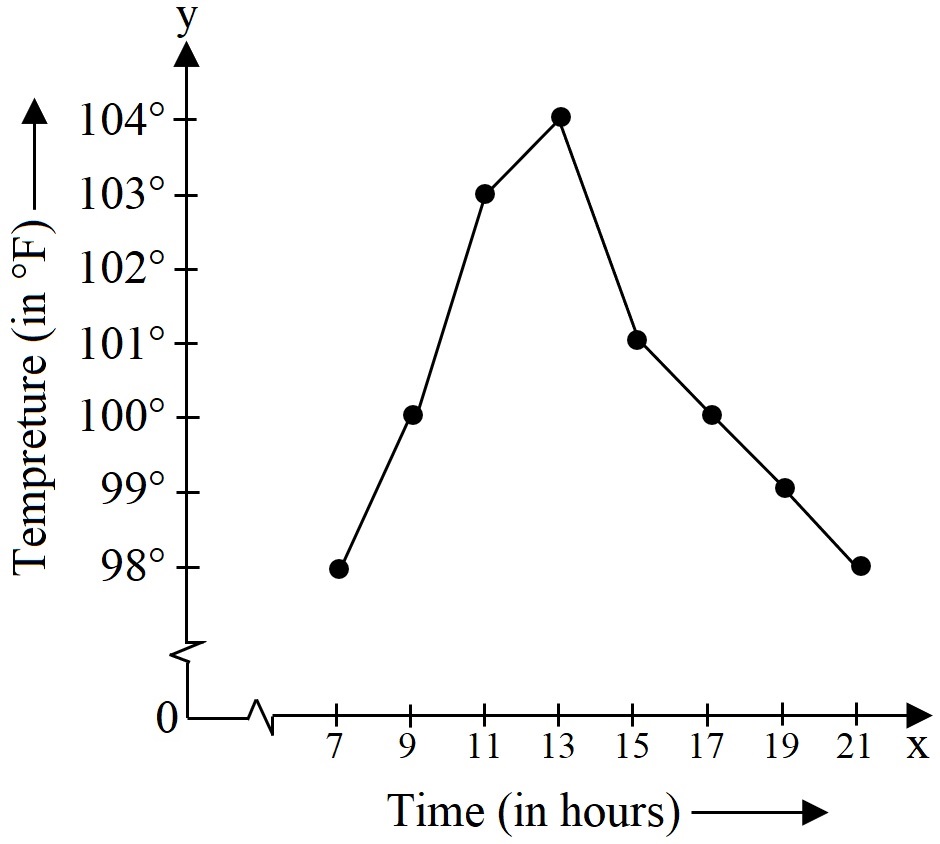
Observe the following temperature time graph and consider it as reasons for the following assertions:

Assertion (A): The coordinates of the origin are (0, 0).
Assertion (A): The ratio 1 : 4 converted to percentage is 25%.
Reasons (R): A ratio can be defined as the relationship or comparison between two numbers of the same unit to check how bigger is one number than the other one.