MCQ
Assertion (A): Between every two rational numbers there exists a unique rational number.
Reason (R): If $x$ and $y$ be two rational numbers such that $x<y$ then $\frac{1}{2}(x+y)$ is a rational number between $x$ and $y$.
  • A
    Both Assertion (A) and Reason (R) are true and Reason (R) is the correct explanation of Assertion (A).
  • B
    Both Assertion (A) and Reason (R) are true and Reason (R) is not the correct explanation of Assertion (A).
  • C
    Assertion (A) is true but Reason (R) is false.
  • Assertion (A) is false but Reason (R) is true.
Answer

Correct option: D.
Assertion (A) is false but Reason (R) is true.
(D) Assertion (A) is false but Reason (R) is true.
Between every two rational numbers there exist infinitely many rational numbers. So. A is false.
Clearly. R is true.

Need a full question paper?

Generate a complete, print-ready paper with questions like this in minutes — across 16+ boards, with answer keys.

Start Generating Free

Similar questions

Assertion (A): The common factor of x2y2 and x3y3 is x2y2
Reasons (R): The factorisation is defined as expressing or decomposing a number or an algebraic expression as a product of its prime factors or irreducible factors.
Directions: In the following questions, the Assertions $(A)$ and Reason(s) $(R)$ have been put forward. Read both the statements carefully and choose the correct alternative from the following:
Assertion (A): The linear equation in one variable $x,$ is $\frac{\text{x}}{2}+\frac{\text{x}}{3}+\frac{1}{4}$
Reason (R): Standard form for linear equation in one variable is $ax + b = 0$. where $x$ is variable and a, b are arbitrary constants
Directions: In the following questions, the Assertions $(A)$ and Reason(s) $(R)$ have been put forward. Read both the statements carefully and choose the correct alternative from the following: Assertion (A): The common factor of $10ab, 30bc, 50ca$ is $10$ Reasons (R): A common factor is a number that can be divided into two different numbers, without leaving a remainder.
Assertion (A): The one’s digit of the cube of the number 326 is 6.
Reasons (R): A cube number is a number multiplied by itself 3 times.
Assertion (A): The number of like terms in 14a2bc, - 23bca2, 25ba2c, - 12cba2 is 2.
Reasons (R): like terms are terms that have the same variables and powers.
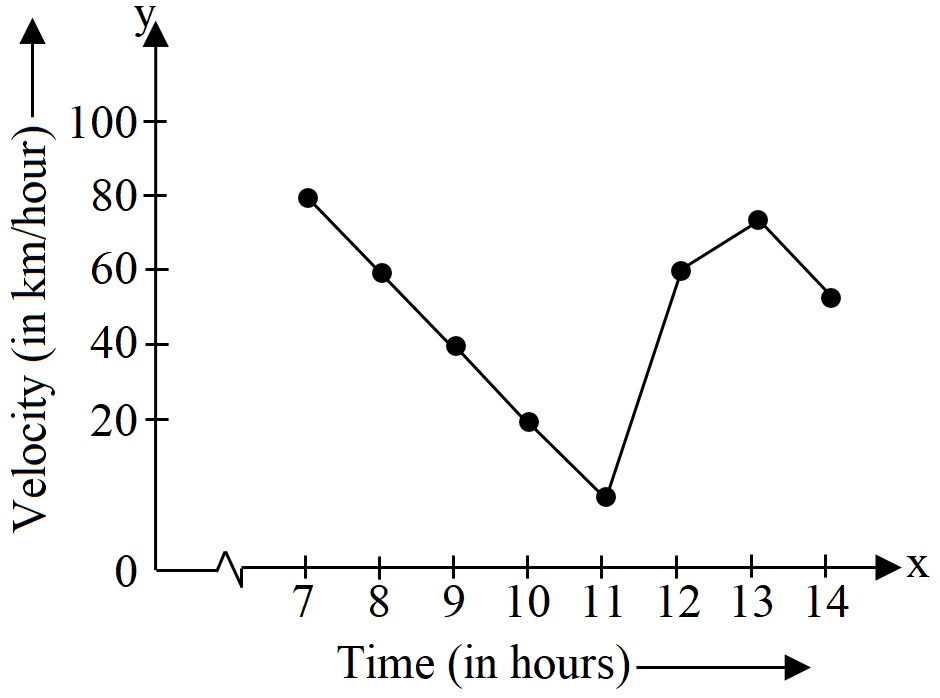
Directions: In the following questions, the Assertions $(A)$ and Reason(s) $(R)$ have been put forward. Read both the statements carefully and choose the correct alternative from the following:Observe the following velocity-time graph and consider it as reasons for the following assertions:

Assertion (A): The fall in velocity from $7$ to $11$ is $90\ km /hour$
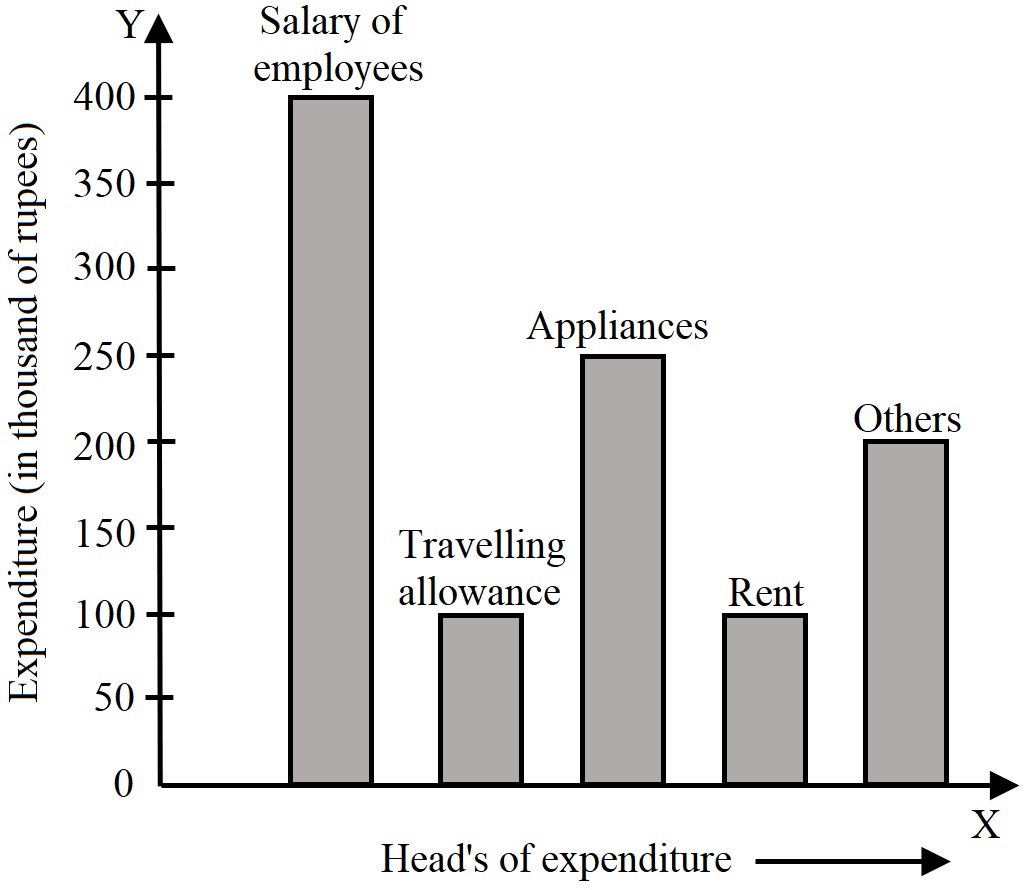
Directions: In the following questions, the Assertions $(A)$ and Reason(s) $(R)$ have been put forward. Read both the statements carefully and choose the correct alternative from the following: Observe the following bar graph and consider it as reasons for the following assertions:
Assertion (A): The sum of the expenditures (in thousands of rupees) on travelling allowance and rent is $200$
Directions: In the following questions, the Assertions $(A)$ and Reason$(s) \ (R)$ have been put forward. Read both the statements carefully and choose the correct alternative from the following:
Assertion $(A):$ Rational numbers are not associative for division
Reason $(R):$ The associative property states that the sum or the product of three or more numbers does not change if they are grouped in a different way.
Directions : In the following questions, the Assertions $(A)$ and Reason $(s) \ (R)$ have been put forward. Read both the statements carefully and choose the correct alternative from the following:
Assertion $(A)$ : Natural numbers are associative for subtraction
Reason $(R)$ : The associative property states that the sum or the product of three or more numbers does not change if they are grouped in a different way.
Assertion (A): The heights of two right circular cylinders are the same. Their volumes are respectively 16 $\pi$ m3 and 81 $\pi$ m3. The ratio of their base radii is 4 : 9
Reasons (R): a ratio indicates how many times one number contains another.