MCQ
Assertion (A): Di-tert-butyl ether cannot be prepared by Williamson's synthesis.
Reason (R): tert-Butyl bromide on treatment with sodium lert-butoxide preferentially undergoes elimination to form isobutylene and rert-butyl alcohol.
  • Both A and R are true and R is the correct explanation of A.
  • B
    Both A and R are true but R is not the correct explanation of A.
  • C
    A is true but R is false.
  • D
    A is false but R is true.

Answer

Correct option: A.
Both A and R are true and R is the correct explanation of A.
(a) Both A and R are true and R is the correct explanation of A.
Explanation: Williamson's synthesis is not applicable to tert. alkyl halides because alkoxide ions being both powerful nucleophiles and bases would bring dehydro-halogenation of the tert. alkyl halides to form alkenes preferentially.

Need a full question paper?

Generate a complete, print-ready paper with questions like this in minutes — across 16+ boards, with answer keys.

Start Generating Free

Similar questions

Note: In the following questions a statement of assertion followed by a statement of reason is given. Choose the correct answer out of the following choices.
Assertion: Enzymes have active sites that hold substrate molecule for a chemical reaction.
Reason: Drugs compete with natural substrate by attaching covalently to the active site of enzyme.
In these questions, a statement of assertion followed by a statement of reason is given. Choose the correct answer out of the following choices.
Assertion: Colloidal sols scatter light while true solutions do not.
Reason: The particles in the colloidal sol move much slower than that of the true solution.
In these questions, a statement of assertion followed by a statement of reason is given. Choose the correct answer out of the following choices.
 Assertion: ln any ionic solid with Schottky defect, the number of positive and negative ions is same.
Reason: Equal number of cationic and anionic vacancies are present.
Note: In the following questions a statement of assertion followed by a statement of reason is given. Choose the correct answer out of the following choices.
Assertion: Like bromination of benzene, bromination of phenol is also carried out in the presence of Lewis acid.
Reason: Lewis acid polarises the bromine molecule.
In these questions, a statement of assertion followed by a statement of reason is given. Choose the correct answer out of the following choices.
Assertion: The pressure exerted by the vapour in equilibrium with a liquid at a given temperature is called its vapour pressure.
Reason: If a non$-$volatile solute is added to a solvent to give a solution, the vapour pressure of the solution is found to be greater than the vapour pressure of the pure solvent.

Note: In the following questions a statement of assertion followed by a statement of reason is given. Choose the correct answer out of the following choices.
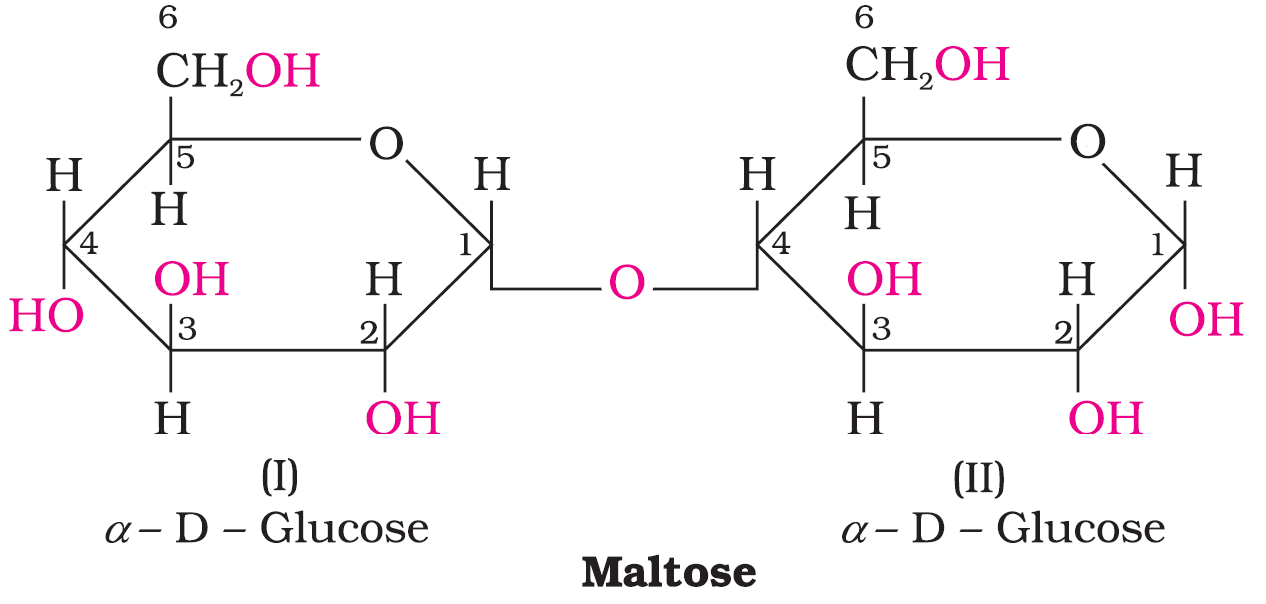
Assertion: $\beta-$glycosidic linkage is present in maltose,

Reason: Maltose is composed of two glucose units in which $C_1$ of one glucose unit is linked to $C_4$ of another glucose unit.
In these questions, a statement of assertion followed by a statement of reason is given. Choose the correct answer out of the following choices.
Assertion: Isopropyl chloride is less reactive than $\ce{CH_3 Br}$ in $S_{N_2}$ reactions.
Reason: $S_{N_2}$ reactions are always accompanied by inversion of configuration.
In these questions, a statement of assertion followed by a statement of reason is given. Choose the correct answer out of the following choices.
Assertion: $p-$Anisidine is weaker base than aniline.
Reason: $\ce{OCH_3}$ group in anisidine exerts $+R$ effect.
Assertion $(A):$ The oxygen of $OH$ group in alcohols is attached to $sp^3$ hybridised carbon.
Reason $(R): $ The bond angle in alcohols $C-O-H$ is $109^\circ \ 28 \ '.$
Assertion $(A): \ce{(CH_3)_3C-O-CH_3}$ gives $\ce{(CH_3)_3C-I}$ and $\ce{CH_3OH}$ on treatment with $HI.$
Reason $(R):$ The reaction occurs by $S_N1$ mechanism.