MCQ
Assertion : A disc-shaped magnet is deviated above a superconducting material that has been cooled by liquid nitrogen.

Reason : Superconductors repel a magnet.

  • If both Assertion and Reason are correct and the Reason is a correct explanation of the Assertion.
  • B
    If both Assertion and Reason are correct but Reason is not a correct explanation of the Assertion.
  • C
    If the Assertion is correct but Reason is incorrect.
  • D
    If both the Assertion and Reason are incorrect.
Answer

Correct option: A.
If both Assertion and Reason are correct and the Reason is a correct explanation of the Assertion.
a
Superconductors are actually diamagnetic in nature so when it is placed above a magnet it will be repelled by magnet or it will tend to move from higher field to lower field. This is  the principle behind leviation of a superconducting material above magnet.

Need a full question paper?

Generate a complete, print-ready paper with questions like this in minutes — across 16+ boards, with answer keys.

Start Generating Free

Similar questions

A galvanometer of resistance $40\,\Omega $ gives a deflection of $5\, divisions$ per $mA$. There are $50\, divisions$ on the scale. The maximum current that can pass through it when a shunt resistance of $2\,\Omega $ is connected is ................ $mA$
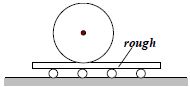
The plank in the figure moves a distance $100\ mm$ to the right while the centre of mass of the sphere of radius $150\, mm$ moves a distance $75\,mm$ to the left. The angular displacement of the sphere (in radian) is (there is no slipping anywhere) :-
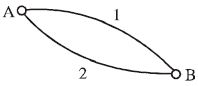
A small body slips, subject to the force of friction, from point $A$ to point $B$ along two curved surfaces of equal radius, first along route $1,$ then along route $2$. Friction does not depend on the speed and the coefficient of friction on both routes is the same. In which case will the body’s speed at $B$ be greater?
When arsenic is added as an impurity to silicon, the resulting material is
Two straight metallic strips each of thickness $t$ and length $\ell$ are rivetted together. Their coefficients of linear expansions are $\alpha_1$ and $\alpha_2$. If they are heated through temperature $\Delta T$, the bimetallic strip will bend to form an arc of radius
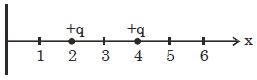
Two charged particles, each with a charge of $+q$, are located along the $x$ -axis at $x = 2$ and $x = 4$, as shown below. Which of the following shows the graph of the magnitude of the electric field along the $x$ -axis from the origin to $x = 6$?
At some temperature $T$, a bronze pin is a little large to fit into a hole drilled in a steel block. The change in temperature required for an exact fit is minimum when
A negatively charged plate has charge density of $2 \times {10^{ - 6}}\,C/{m^2}$. The initial distance of an electron which is moving toward plate, cannot strike the plate, if it is having energy of $200\,eV$
The decay constant of a radio active substance is $0.173\, (years)^{-1}.$ Therefore :
A cubical solid aluminium (bulk modulus $=-V \frac{ dP }{ dV }=70 GPa$ ) block has an edge length of $1 m$ on the surface of the earth. It is kept on the floor of a $5 km$ deep ocean. Taking the average density of water and the acceleration due to gravity to be $10^3 kg m ^{-3}$ and $10 ms ^{-2}$, respectively, the change in the edge length of the block in $mm$ is . . . . .