MCQ
$Assertion$ : A helicopter must necessarily have two propellers.
$Reason$ : Two propellers are provided in helicopter in order to conserve linear momentum
  • A
    If both Assertion and Reason are correct and the Reason is a correct explanation of the Assertion.
  • B
    If both Assertion and Reason are correct but Reason is not a correct explanation of the Assertion.
  • If the Assertion is correct but Reason is incorrect.
  • D
    If both the Assertion and Reason are incorrect.
Answer

Correct option: C.
If the Assertion is correct but Reason is incorrect.
c
If there were only one propeller in the helicopter, the helicopter itself, would have turned in opposite direction of the direction of propeller due to conservation of angular momentum. Thus two propeller provides helicopter a steady movement.

Need a full question paper?

Generate a complete, print-ready paper with questions like this in minutes — across 16+ boards, with answer keys.

Start Generating Free

Similar questions

It is found that if a neutron suffers an elastic collinear collision with deuterium at rest, fractional loss of its energy is $p_d $ ; while for its similar collision with carbon nucleus at rest, fractional loss of energy is $P_c$. The values of $P_d$ and $P_c$ are respectively
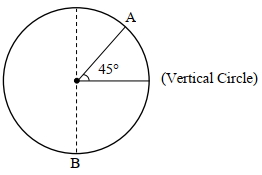
A body of $\mathrm{m} \mathrm{kg}$ slides from rest along the curve of vertical circle from point $A$ to $B$ in friction less path. The velocity of the body at $B$ is:

(given, $\mathrm{R}=14 \mathrm{~m}, \mathrm{~g}=10 \mathrm{~m} / \mathrm{s}^2$ and $\sqrt{2}=1.4$ )

Starting from rest, a body slides down a $45^°$ inclined plane in twice the time it takes to slide down the same distance in the absence of friction. The coefficient of friction between the body and the inclined plane is
Two springs of force constants $300\, N / m$ (Spring $A$) and $400$ $N / m$ (Spring $B$ ) are joined together in series. The combination is compressed by $8.75\, cm .$ The ratio of energy stored in $A$ and $B$ is $\frac{E_{A}}{E_{B}} .$ Then $\frac{E_{A}}{E_{B}}$ is equal to
Two different liquids are flowing in two tubes of equal radius. The ratio of coefficients of viscosity of liquids is $52:49$ and the ratio of their densities is $13:1$, then the ratio of their critical velocities will be
A body of mass $m$ moving with velocity $v$ makes a head on perfectly inelastic collision with another body of mass $2\,m$ which is initially at rest. Then percentage loss in the kinetic energy 
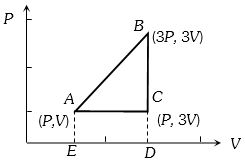
An ideal gas is taken around $ABCA$ as shown in the above $P-V$ diagram. The work done during a cycle is
Two sitar strings $A$ and $B$ playing the note $'Ga'$ are slightly out of tune and produce beats of frequency $6\,Hz$ . The tension in the string $A$ is slightly reduced and the beat frequency is found to reduce to $3\,Hz$. If the original frequency of $A$ is $324\,Hz$, what is the frequency of $B$ ..... $Hz$
In a typical combustion engine the work done by a gas molecule is given $W =\alpha^{2} \beta e ^{\frac{-\beta x ^{2}}{ KT }}$, where $x$ is the displacement, $k$ is the Boltzmann constant and $T$ is the temperature. If $\alpha$ and $\beta$ are constants, dimensions of $\alpha$ will be
Given radius of Earth $‘R’$ and length of a day $‘T’$ the height of a geostationary satellite is [$G-$Gravitational Constant, $M-$Mass of Earth]