Question
Assertion $(A):$ If set $A$ contains $7$ elements and set $B$ contains $6$ elements, then the number of one$-$one onto mapping from $A$ to $B$ is $420 $.
Reason $(R):$ If $A$ and $B$ are two non$-$empty sets containing $m$ and $n$ elements respectively, then number of one$-$one onto functions from $A$ to $B =\left\{\begin{array}{l}n !, \text { if } m=n \\0, \text { if } m \neq n\end{array}\right. \text {. }$
Answer

Clearly, reason is true.
Now, $m=7$ and $n=6$ i.e., $m \neq n$
$\therefore$ Number of one$-$one onto mapping from $A$ to $B$ is $0$ .
$\therefore$ Assertion is false and Reason is true. 

Need a full question paper?

Generate a complete, print-ready paper with questions like this in minutes — across 16+ boards, with answer keys.

Start Generating Free

Similar questions

Directions: In the following questions, a statement of assertion $(A)$ is followed by a statement of reason $(R)$. Mark the correct choice as:
Assertion: If $\text{A}=\begin{pmatrix}1 \pi 0 1\end{pmatrix},$ then $\text{A}^{100}=\begin{pmatrix}1 100\pi 0 1\end{pmatrix}.$
Reason: If $B$ is matrix of order $2X2$ and $B^2 = O$, then $(I + B)^n = I + nB$, for all $\text{n}\in\text{N}.$
Assertion (A): If $A=\{x \in z: 0 \leq x \leq 12\}$ and R is the relation in A given by $R =\{( a , b ): a = b$.Then, the set of all elements related to 1 is {1, 2}.
Reason (R): If $R _1$ and $R _2$ are equivalence relation in a set A , then $R_1 \cap R_2$ is an equivalence relation.
Directions: In the following questions, a statement of assertion (A) is followed by a statement of reason (R). Mark the correct choice as:
Assertion: If $0<\text{x}\leq\frac{\pi}{2},$ then $\sin^{-1}(\cos\text{x})+\cos^{-1}(\sin\text{x})=\pi-2\text{x}.$
Reason: $\cos^{-1}\text{x}=\frac{\pi}{2}-\sin^{-1}\text{x} $ for all $\text{x}\in[-1,1].$
  1. Both A and R are true and R is the correct explanation of A.
  2. Both A and R are true but R is not the correct explanation of A.
  3. A is true but R is false.
  4. A is false but R is true.
  5. Both A and R are false.
Directions: In the following questions, the Assertions (A) and Reason(s) (R) have been put forward. Read both the statements carefully and choose the correct alternative from the following:
Assertion(A): $\text{f(x)}=\sin\text{x}$ is continuous x = 0.
Reason(R): $\sin\text{x}$ is differentiable at x = 0.
  1. Both A and R are true and R is the correct explanation of A
  2. Both A and R are true but R is NOT the correct explanation of A
  3. A is true but R is false.
  4. A is false but R is true.
Assertion (A): The matrix $A=\left(\begin{array}{ccc}0 & a & b \\ -a & 0 & c \\ -b & -c & 0\end{array}\right)$ is a skew-symmetric matrix.
Reason (R) : A square matrix $A=\left(a_{i j}\right)$ of order $m$ is said to be skew-symmetric if $A^T=-A$.
Directions: In the following questions, the Assertions (A) and Reason(s) (R) have been put forward. Read both the statements carefully and choose the correct alternative from the following:
Assertion (A): Feasible region is the set of points which satisfy all of the given constraints.
Reason (R): The optimal value of the objective function is attained at the points on X - axisonly.
  1. Both A and R are true and R is the correct explanation of A
  2. Both A and R are true but R is NOT the correct explanation of A
  3. A is true but R is false.
  4. A is false but R is true.
Directions: In the following questions, the Assertions (A) and Reason(s) (R) have been put forward. Read both the statements carefully and choose the correct alternative from the following:
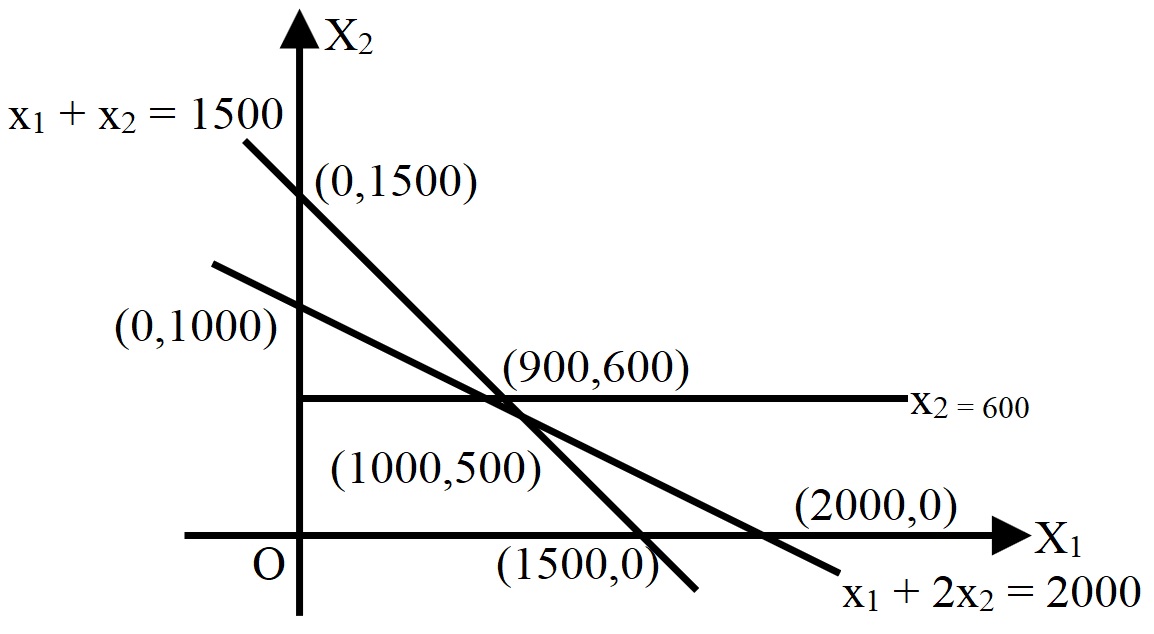
Assertion (A): For the constraints of a LPP problem given by $\text{x}_1+2\text{x}_2\leq2000,\text{x}_1+\text{x}_2\leq1500,\text{x}^2\leq600$ and $\text{x}_1,\text{x}_2\geq0$ the points (1000, 0), (0, 500), (2, 0) lie in the positive bounded region, but point (2000, 0) does not lie in the positive boundedregion.
Reason (R):
  1. Both A and R are true and R is the correct explanation of A
  2. Both A and R are true but R is NOT the correct explanation of A
  3. A is true but R is false.
  4. A is false but R is true.
Directions: In the following questions, a statement of assertion $(A)$ is followed by a statement of reason $(R)$. Mark the correct choice as:
Assertion: If $X = {0, 1, 2}$ and the function defined by $f(x) = x^2 - 2$ is surjection then $Y = {-2, -1, 0}$.
Reason: If $f : X \rightarrow Y$ is surjective if $f(X) = Y$.
Assertion (A) : The inverse of $A=\left(\begin{array}{ll}3 & 4 \\ 3 & 5\end{array}\right)$ does not exist.
Reason (R) : The matrix $A$ is non-singular.
Directions: In the following questions, the Assertions (A) and Reason(s) (R) have been put forward. Read both the statements carefully and choose the correct alternative from the following:
Assertion (A): The region represented by the set $\{(\text{x},\text{y}):4\leq\text{x}^2+\text{y}^2\leq9\}$ is a convex set.
Reason (R): The set $\{(\text{x},\text{y}):4\leq\text{x}^2+\text{y}^2\leq9\}$ represents the region between two concentric circles of radii 2 and 3.
  1. Both A and R are true and R is the correct explanation of A
  2. Both A and R are true but R is NOT the correct explanation of A
  3. A is true but R is false.
  4. A is false but R is true.