MCQ
Assertion (A): If two squares have equal areas, they are congruent.
Reason (R): If two rectangles have equal areas, they are congruent.
  • A
    Both Assertion (A) and Reason (R) are true and Reason (R) is the correct explanation of Assertion (A).
  • B
    Both Assertion (A) and Reason (R) are true and Reason (R) is not the correct explanation of Assertion (A).
  • Assertion (A) is true but Reason (R) is false.
  • D
    Assertion (A) is false but Reason (R) is true.
Answer

Correct option: C.
Assertion (A) is true but Reason (R) is false.
(c): Area of a square with sides of length ' $a$ ' is $a^2$.
So, if two squares have equal areas then they have equal side length and therefore they are congruent.
$\therefore A$ is true.
Consider two rectangles one having $l=10 cm, b=2 cm$ and the other having $l=5 cm$, $b=4 cm$.
Both rectangles have the same area of $20 cm^2$ but they are not congruent since they do not have the same length and breadth. $\therefore R$ is false.

Need a full question paper?

Generate a complete, print-ready paper with questions like this in minutes — across 16+ boards, with answer keys.

Start Generating Free

Similar questions

Directions: In the following questions, the Assertions $(A)$ and Reason$(s)$ $(R)$ have been put forward. Read both the statements carefully and choose the correct alternative from the following:
Assertion: It has line of symmetry
Reason: The line of symmetry is a line that divides an object into two identical pieces
Directions: In the following questions, the Assertions $(A)$ and Reason$(s)$ $(R)$ have been put forward. Read both the statements carefully and choose the correct alternative from the following:
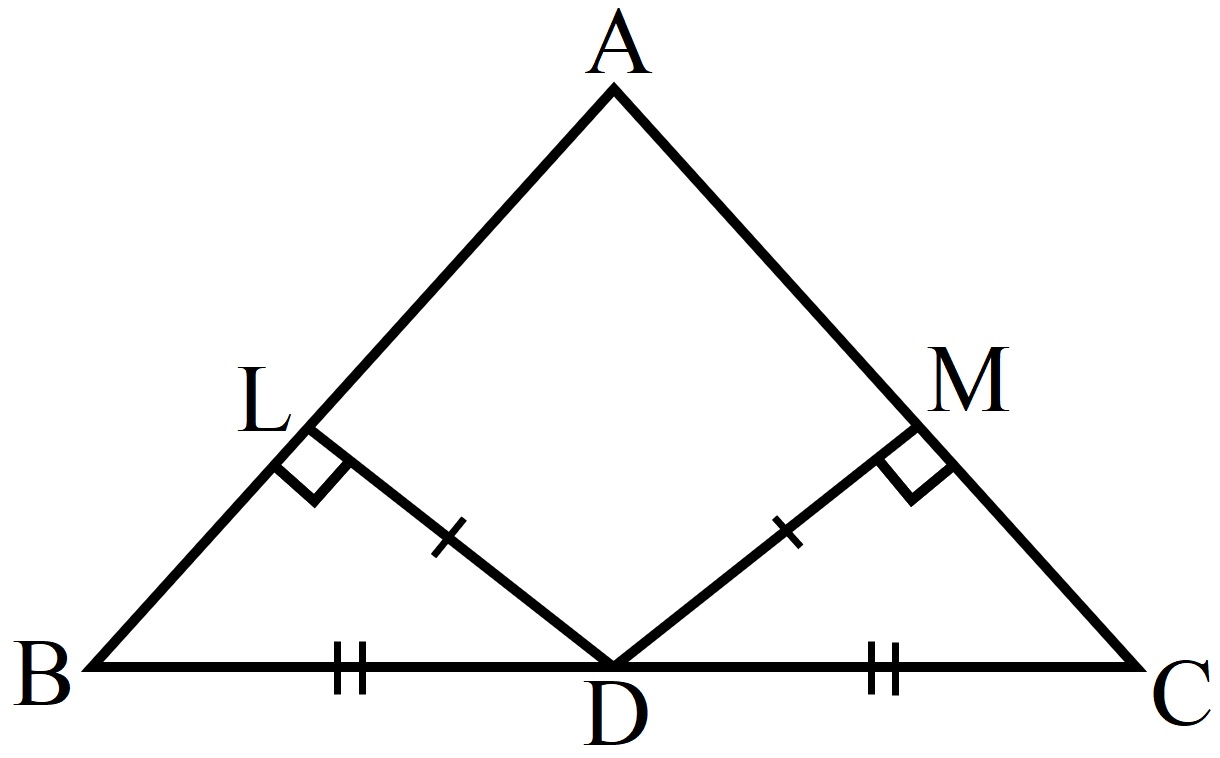
Assertion : In $\triangle\text{ABC}$, $D$ is the midpoint of $BC$. If $DL I AB$ and $DM I AC$ such that $DL = DM$, then $BL = CM$
Reason: If two angles and the included side of one triangle are equal to two angles
Assertion (A): The root of the equation $3 x-8=4$ is $x=4$.
Reason (R): The root of a linear equation is the value of $x$ equal to the right-hand side of the equation.
Directions: In the following questions, the Assertions $(A)$ and Reason$(s)$ $(R)$ have been put forward. Read both the statements carefully and choose the correct alternative from the following:
Assertion: The supplement of the angle $(120 + a - 2b)^\circ $ is $(60 - a + 2b) ^\circ $
Reason: If the sum of two angle is $180^\circ $ then the angle are supplementary.
Directions: In the following questions, the Assertions $(A)$ and Reason$(s)$ $(R)$ have been put forward. Read both the statements carefully and choose the correct alternative from the following:
Assertion: Numerical coefficient is defined as a unfixed number that is multiplied to a variable
Reason: The value $4 x^3+3 x^2+7$ when $\text{x}=\frac{1}{2}$ is $6$
Directions: In the following questions, the Assertions $(A)$ and Reason$(s)$ $(R)$ have been put forward. Read both the statements carefully and choose the correct alternative from the following:
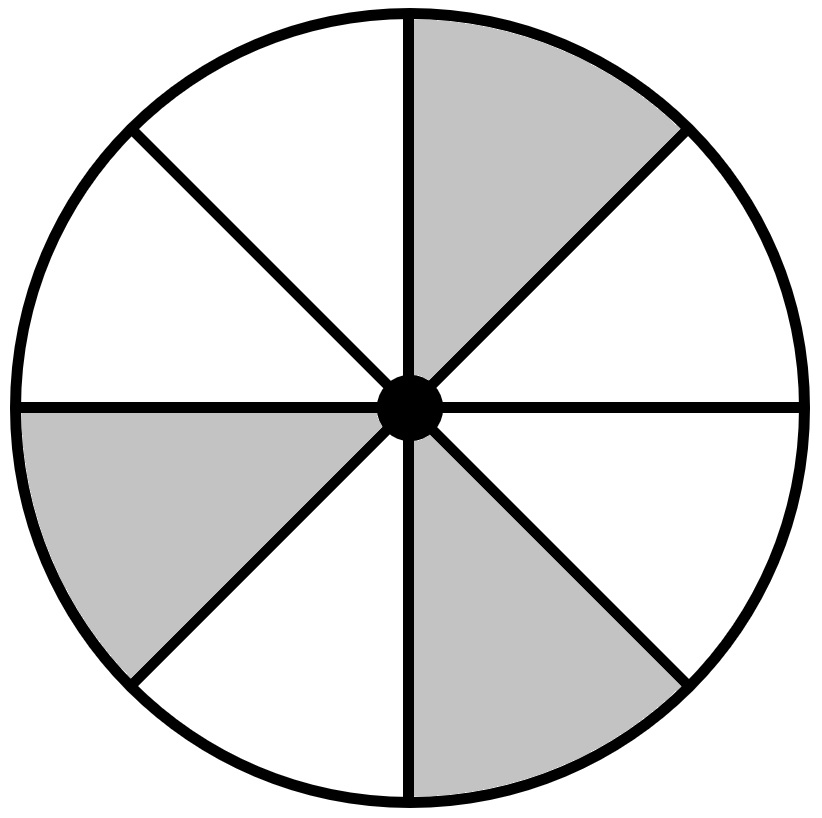
Assertion:

given figure shows a proper fraction.
Reason: $\frac{4}{7}$ is an example of proper fraction
Directions: In the following questions, the Assertions $(A)$ and Reason$(s)$
$(R)$ have been put forward. Read both the statements carefully and choose the correct alternative from the following:
Assertion: If one angle of linear pair is $102^\circ $, then the other angle will be $78^\circ $.
Reason: Sum of angles of linear pair is $180$^\circ .
Directions: In the following questions, the Assertions $(A)$ and Reason$(s)$ $(R)$ have been put forward. Read both the statements carefully and choose the correct alternative from the following:
Assertion: Interest is the amount of money paid for a loan or an investment.
Reason: The principal is the amount of money borrowed or invested.
Assertion (A): For any three integers $a, b, c$, we have $a \times(b+c)=(a \times b)+(a \times c)$.
Reason (R): The associative law of multiplication holds for integers.
Directions: In the following questions, the Assertions $(A)$ and Reason$(s)$ $(R)$ have been put forward. Read both the statements carefully and choose the correct alternative from the following:
Assertion: The discount is always applied to the article’s marked price.
Reason: Discount=marked price–selling price.