Assertion $(A):$ In a meter bridge experiment, null point for an unknown resistance is put inside an enclosure maintained at a higher temperature. The null point can be obtained at the same $p$ as before by decreasing the value of the standard resistance.
Reason $(R):$ Resistance of metal increases with increase in temperature.
AIIMS 2015, Medium
Download our app for free and get started
(d)

Download our appand get started for free
Experience the future of education. Simply download our apps or reach out to us for more information. Let's shape the future of learning together!No signup needed.*
Similar Questions
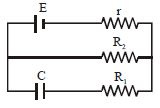
- 1In the given figure each plate of capacitance $C$ has partial value of chargeView Solution
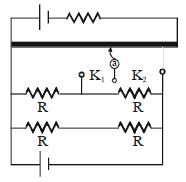
- 2In potentiometer experiment when $K_1$ is closed balance length is $100\,cm$. Then what will be balancing length when $K_2$ is closed ................ $\mathrm{cm}$View Solution
- 3Two resistances are connected in two gaps of a meter bridge. The balance point is $20\, cm$ from the zero end. A resistance of $15\, ohms$ is connected in series with the smaller of the two. The null point shifts to $40\, cm$. The value of the smaller resistance in $ohms$ isView Solution
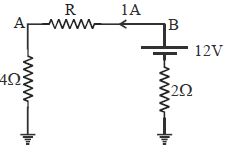
- 4View SolutionIn the given circuit
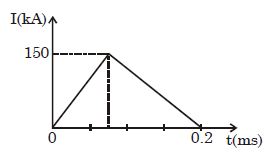
- 5During lighting, a current pulse, shown in figure, flows from the cloud at a height $1.5\ km$ to the ground. If the breakdown electric field of humid air is about $400\ kVm^{-1}$ , the energy released during lighting would be (in unit of $10^9\ J$ )View Solution
- 6View SolutionAn energy source will supply a constant current into the load if its internal resistance is
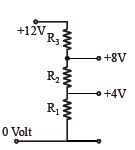
- 7A potential divider is used to give outputs of $4\,V$ and $8\,V$ from a $12\,V$ source. Which combination of resistances, $(R_1 : R_2 : R_3)$ gives the correct voltagesView Solution
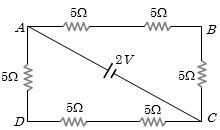
- 8The potential difference between points $A$ and $B$ of adjoining figure isView Solution
- 9Two cells of emf $E_1$ and $E_2\left(E_1 > E_2\right)$ are connected individually to a potentiometer and their corresponding balancing length are $625 \,cm$ and $500 \,cm$, then the ratio $\frac{E_1}{E_2}$ is ...........View Solution
- 10If a $2\, kW$ boiler is used everyday for $1$ hour, then electrical energy consumed by boiler in thirty days is .......... $uint$View Solution