MCQ
Assertion (A) : Let $f:(e, \infty) \rightarrow R$ defined by $f(x)=\log (\log (\log x))$ is bijective.
Reason (R) : A function $f$ will be bijective if $f$ is both one-one and onto.
  • Both (A) and (R) are true and (R) is the correct explanation of (A).
  • B
    Both (A) and (R) are true but (R) is not the correct explanation of (A).
  • C
    (A) is true but (R) is false.
  • D
    (A) is false but (R) is true.

Answer

Correct option: A.
Both (A) and (R) are true and (R) is the correct explanation of (A).
(a) : As $x \in(e, \infty)$
$\Rightarrow \log x>1 \Rightarrow \log (\log x)>\log 1$
$\Rightarrow \log (\log x)>0$
$\Rightarrow \log (\log (\log (x))>\log 0$
$\Rightarrow \log (\log (\log x)) \in(-\infty, \infty)$
$\Rightarrow$ codomain of $f(x)=$ Range of $f(x) \Rightarrow f$ is onto
Again logarithmic functions are always one-one.
$\therefore f(x)$ is both one - one and onto.

Need a full question paper?

Generate a complete, print-ready paper with questions like this in minutes — across 16+ boards, with answer keys.

Start Generating Free

Similar questions

Directions : In these questions, a statement of Assertion is followed by a statement of Reason is given. Choose the correct answer out of the following choices :
Assertion : The area of the smaller region bounded by the ellipse $\frac{\text{x}^2}{9}+\frac{\text{y}^2}{4}=1$ the line $\frac{\text{x}}{3}+\frac{\text{y}}{2}=1$ is $\frac{3}{2}(\pi-2)\text{ sq.units}$
Reason : Formula to calculate the area of the smaller region bounded by the ellipse $\frac{\text{x}^2}{\text{a}^2}+\frac{\text{y}^2}{\text{b}^2}=1$ and the line $\frac{\text{x}}{\text{a}}+\frac{\text{y}}{\text{b}}=1$ is $\frac{\text{ab}}{4}(\pi-2) \text{ sq.units}$
A man $P$ speaks truth with probability $p$ and an other $\operatorname{man} Q$ speaks truth with probability $2 p$.
Assertion $(A)$ : If $P$ and $Q$ contradict each other with probability $1 / 2, $ then there are two values of $p$.
Reason $(R)$ : A quadratic equation with real coefficients has two real roots.
Directions: In the following questions, a statement of assertion $(A)$ is followed by a statement of reason $(R).$ Mark the correct choice as:
Assertion: The equation of the line joining $(1, 2)$ and $(3, 6)$ using deter`minants is $y = 3x.$
Reason: The area of $\triangle\text{PAB}$ is zero if $P(x, y)$ is a point on the line joining a $A$ and $B.$
Directions: In the following questions, the Assertions $(A)$ and Reason$(s) (R)$ have been put forward. Read both the statements carefully and choose the correct alternative from the following
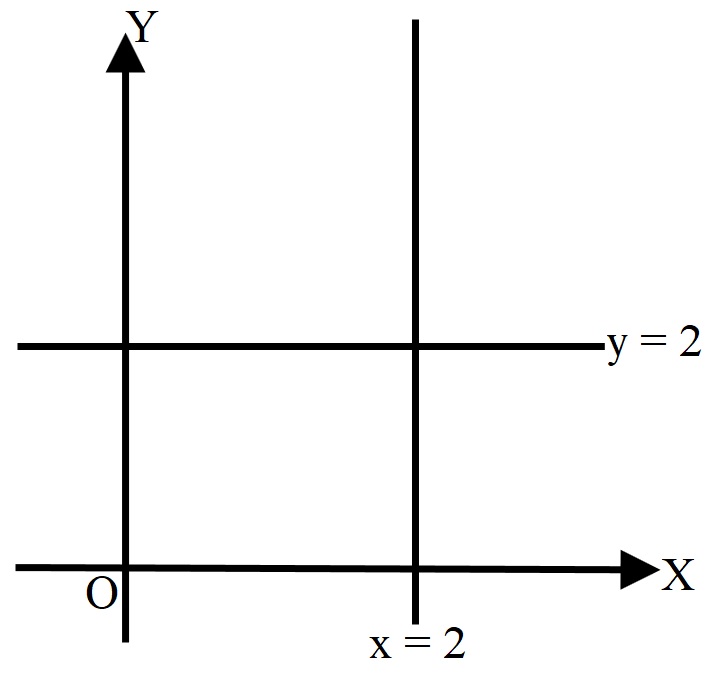
Assertion $(A):$ The graph of $\text{x}\leq2$ and $\text{y}\geq2$ will be situated in the first and second quadrants.
Reason $(R):$
Assertion (A): The area bounded by the parabola $y^2=4 a x$ and the line $x=a$ and $x=4 a$ is $\frac{56 a^2}{3}$ sq. units.
Reason (R) : The area bounded by the parabola $y^2=49 x$ and $y=m x$ is $8 a^2 / 3 m^3$ sq. units.
Directions: In the following questions, a statement of assertion $(A)$ is followed by a statement of reason $(R).$ Mark the correct choice as:
Assertion: Let $\text{A}^{-1}=\begin{bmatrix}5&-7\\-2&3\end{bmatrix}$ and $\text{B}^{-1}=\begin{bmatrix}7&6\\8&7\end{bmatrix}$ then $(\text{AB})^{-1}=\begin{bmatrix}23&31\\26&35\end{bmatrix}.$
Reason: $(\text{AB})^{-1}=\text{A}^{-1}\text{B}^{-1}.$
Directions : In the following questions, the Assertions $(A)$ and Reason $(s) \ (R)$ have been put forward. Read both the statements carefully and choose the correct alternative from the following :
Assertion $(A)$ If $\text{f(x)}=\cos,$ then $\text{ f '}\Big(\frac{\pi}{4}\Big)=\frac{-1}{\sqrt{2}}$ and $\text{ f '}\Big(\frac{3\pi}{4}\Big)=\frac{1}{\sqrt{2}}$
Reason $(R) : \text{f(x)}=\cos=\begin{cases}\cos\text{x },0\leq\text{x} \leq\frac{\pi}{2}\\-\cos\text{x },\text{if }\frac{\pi}{2} < \text{x}\leq\pi\end{cases}$
Directions : In the following questions, a statement of assertion $(A)$ is followed by a statement of reason $(R).$ Mark the correct choice as :
Assertion : If $\text{A}=\begin{pmatrix}1 & 2 & -1\\ 2 & 0 & 3 \\ -1& 3 & 4 \end{pmatrix},$ then $A^{-1}$ is symmetric matrix.
Reason : If $A$ is symmetric matrix then $A^{-1}$ is symmetric matrix.
Directions : In these questions, a statement of Assertion is followed by a statement of Reason is given.Choose the correct answer out of the following choices:
Assertion : Order of the differential equation whose solution is $\text{y}=\text{c}_1\text{e}^{\text{x}+\text{c}_2}+\text{c}_3\text{e}^{\text{x}+\text{c}_4}$ is $4.$
Reason : Order of the differential equation is equal to the number of independent arbitrary constants mentioned in the solution of the differential equation.
Directions: In the following questions, the Assertions $(A)$ and Reason$(s) (R)$ have been put forward. Read both the statements carefully and choose the correct alternative from the following:
Assertion: Maximum value of $z = 11x + 7y,$ subjectto constraints $2\text{x}+\text{y}\leq6,\text{x}\leq2,\text{x}\geq0,\text{y}\geq0$ will be obtained at $(0, 6).$
Reason: In a bounded feasible region, it always exist a maximum and minimum value.