MCQ
Assertion (A) : Let $f:(e, \infty) \rightarrow R$ defined by $f(x)=\log (\log (\log x))$ is bijective.
Reason (R) : A function $f$ will be bijective if $f$ is both one-one and onto.
  • Both (A) and (R) are true and (R) is the correct explanation of (A).
  • B
    Both (A) and (R) are true but (R) is not the correct explanation of (A).
  • C
    (A) is true but (R) is false.
  • D
    (A) is false but (R) is true.

Answer

Correct option: A.
Both (A) and (R) are true and (R) is the correct explanation of (A).
(a) : As $x \in(e, \infty)$
$\Rightarrow \log x>1 \Rightarrow \log (\log x)>\log 1$
$\Rightarrow \log (\log x)>0$
$\Rightarrow \log (\log (\log (x))>\log 0$
$\Rightarrow \log (\log (\log x)) \in(-\infty, \infty)$
$\Rightarrow$ codomain of $f(x)=$ Range of $f(x) \Rightarrow f$ is onto
Again logarithmic functions are always one-one.
$\therefore f(x)$ is both one - one and onto.

Need a full question paper?

Generate a complete, print-ready paper with questions like this in minutes — across 16+ boards, with answer keys.

Start Generating Free

Similar questions

Directions: In the following questions, the Assertions (A) and Reason(s) (R) have been put forward. Read both the statements carefully and choose the correct alternative from the following:
Assertion (A): If an LPP attains its maximum value at two corner points of the feasible region then it attains maximum value at infinitely many points.
Reason (R): if the value of the objective function of a LPP is same at two corners then it is same at every point on the line joining two corner points.
  1. Both A and R are true and R is the correct explanation of A
  2. Both A and R are true but R is NOT the correct explanation of A
  3. A is true but R is false.
  4. A is false but R is true.
Directions: In the following questions, a statement of assertion (A) is followed by a statement of reason (R). Mark the correct choice as:
Assertion: Suppose $\text{X}=\begin{pmatrix}\text{a}&\text{b}\\\text{c}&\text{d}\end{pmatrix}$ satisfies X2 - 4X + 3I = O. : If $\text{a}+\text{d}\neq4,$ then there are just two matrices such X.
Reason: There are infinitely many matrices X satisfies the equation X2 - 4X + 3I = O.
  1. Both A and R are true and R is the correct explanation of A.
  2. Both A and R are true but R is not the correct explanation of A.
  3. A is true but R is false.
  4. A is false but R is true.
  5. Both A and R are false.
Directions: In the following questions, the Assertions (A) and Reason(s) (R) have been put forward. Read both the statements carefully and choose the correct alternative from the following:

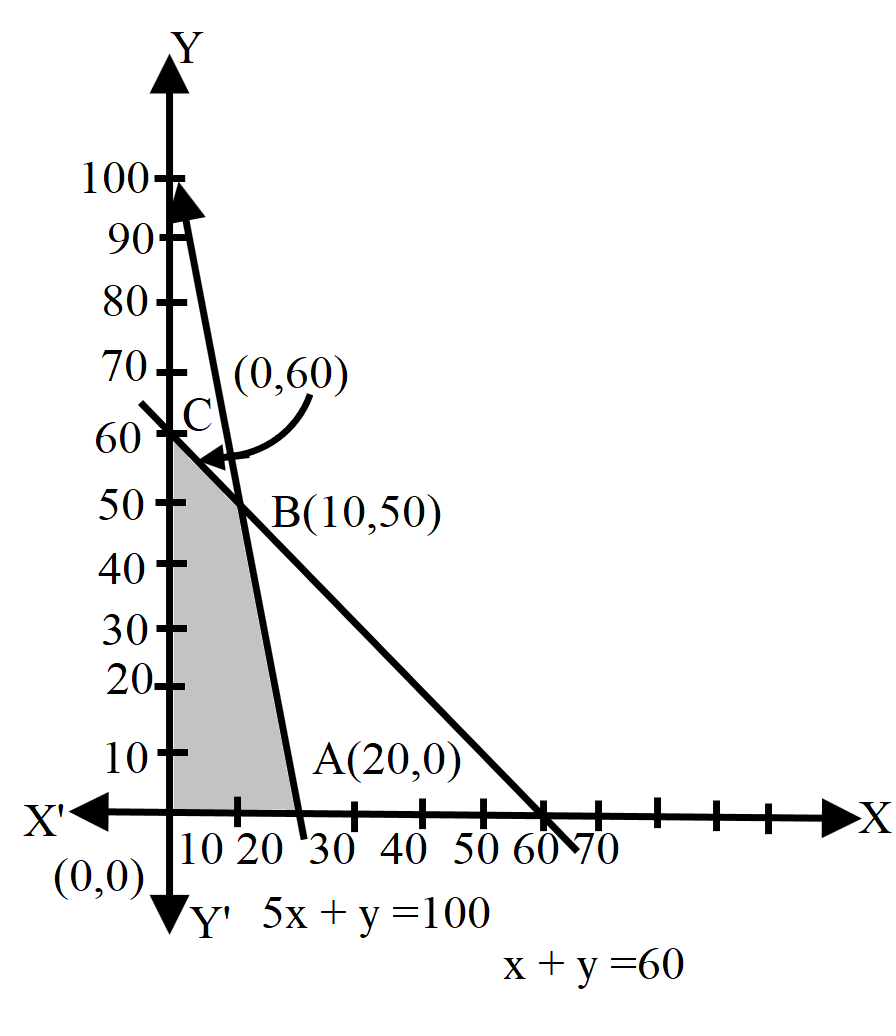
Consider, the graph of constraints stated as linear inequalities as below:

$5\text{x}+\text{y}\leq100,\text{x}+\text{y}\leq60,\text{x},\text{y}\geq0.$

Assertion (A): (25, 40) is an infeasible solution of the problem.

Reason (R): Any point inside the feasible region is called an infeasible solution.

  1. Both A and R are true and R is the correct explanation of A
  2. Both A and R are true but R is NOT the correct explanation of A
  3. A is true but R is false.
  4. A is false but R is true.
Assertion (A) : If $y=\cot ^{-1}\left(\frac{1+x \sqrt{x}}{\sqrt{x}-x}\right)$, then $\frac{d y}{d x}=\frac{-1}{1+x^2}+\frac{1}{2 \sqrt{x}(1+x)}$
Reason (R) : $\frac{d}{d x}\left(\tan ^{-1} x\right)=\frac{1}{1+x^2}$ and $\frac{d}{d x}\left(\tan ^{-1} \frac{1}{x}\right)=1+x^2$.
Assertion (A) : The function $f: R \rightarrow[0,1)$ defined by $f(x)=\frac{x^2}{x^2+1}$ is surjective.
Reason (R) : For surjection, Range of $f(x)=$ codomain of $f(x)$
Directions: In the following questions, a statement of assertion (A) is followed by a statement of reason (R). Mark the correct choice as:
Assertion: $\text{cosec}^{-1}\Big(\frac{1}{2}+\frac{1}{\sqrt{2}}\Big)>\sec^{-1}\Big(\frac{1}{2}+\frac{1}{\sqrt{2}}\Big).$
Reason: $\text{cosec}^{-1}(\text{x})>\sec^{-1}(\text{x})$ if $1<\text{x}<\sqrt{2}.$
  1. Both A and R are true and R is the correct explanation of A.
  2. Both A and R are true but R is not the correct explanation of A.
  3. A is true but R is false.
  4. A is false but R is true.
  5. Both A and R are false.
Directions: In the following questions, the Assertions (A) and Reason(s) (R) have been put forward. Read both the statements carefully and choose the correct alternative from the following:
Assertion (A): The region represented by the set $\{(\text{x},\text{y}):4\leq\text{x}^2+\text{y}^2\leq9\}$ is a convex set.
Reason (R): The set $\{(\text{x},\text{y}):4\leq\text{x}^2+\text{y}^2\leq9\}$ represents the region between two concentric circles of radii 2 and 3.
  1. Both A and R are true and R is the correct explanation of A
  2. Both A and R are true but R is NOT the correct explanation of A
  3. A is true but R is false.
  4. A is false but R is true.
Let $A=\left[\begin{array}{ccc}1 & 0 & a \\ 2 & 3 & b \\ -3 & 1 & c\end{array}\right], B=\left[\begin{array}{ccc}1 & 0 & x \\ 2 & 3 & y \\ -3 & 1 & z\end{array}\right]$
and $C=\left[\begin{array}{ccc}1 & 0 & a+x \\ 2 & 3 & b+y \\ -3 & 1 & c+z\end{array}\right]$.
Assertion (A) : $\operatorname{det} A+\operatorname{det} B=\operatorname{det} C$.
Reason (R) : $A+B=C$.
Directions: In these questions, a statement of Assertion is followed by a statement of Reason is given.Choose the correct answer out of the following choices:
Assertion: The adjacent sides of a parallelogramarealong $\overline{\text{a}}=\hat{\text{i}}+2\hat{\text{j}}$ and $\overline{\text{b}}=2\hat{\text{i}}+\hat{\text{j}}$ The angle between the diagonals is $150^\circ$.
Reason: Two vectors are perpendicular to each other if their dot product is zero.
  1. Assertion and Reason both are correct statements and Reason is the correct explanation of Assertion.
  2. Assertion and Reason both are correct statements but Reason is not the correct explanation of Assertion.
  3. Assertion is correct statement but Reason is wrong statement.
  4. Assertion is wrong statement but Reason is correct statement.
Assertion (A) : $A=\left[\begin{array}{ll}2 & 3 \\ 1 & 4\end{array}\right], B=\left[\begin{array}{ll}1 & 0 \\ 0 & 1\end{array}\right]$, then $(A+B)^2=A^2+B^2+2 A B$.
Reason (R): For the matrices $A$ and $B$ given in assertion, $A B=B A$.