MCQ
Assertion (A) : Order of the differential equation whose solution is $y=c_1 e^{x+c_2}+c_3 e^{x+c_4}$ is 4.
Reason (R) : Order of the differential equation is equal to the number of independent arbitrary constants mentioned in the solution of the differential equation.
  • A
    Both (A) and (R) are true and (R) is the correct explanation of (A).
  • B
    Both (A) and (R) are true but (R) is not the correct explanation of (A).
  • C
    (A) is true but (R) is false.
  • (A) is false but (R) is true.

Answer

Correct option: D.
(A) is false but (R) is true.
(d): $\because y=\left(c_1 e^{c_2}+c_3 e^{c_4}\right) e^x=c e^x$ ...(i)
Solution of differential equation containing the arbitrary constant.
$\therefore \quad$ Order is 1.

Need a full question paper?

Generate a complete, print-ready paper with questions like this in minutes — across 16+ boards, with answer keys.

Start Generating Free

Similar questions

Directions : In the following questions, the Assertions $(A)$ and Reason $(s)\ (R)$ have been put forward. Read both the statements carefully and choose the correct alternative from the following :
Assertion : In $\triangle\text{ABC},\overrightarrow{\text{AB}}+\overrightarrow{\text{BC}}+\overrightarrow{\text{CA}}=0.$
Reason : If $\overrightarrow{\text{OA}}=\overrightarrow{\text{a}},\overrightarrow{\text{OB}},\overrightarrow{\text{b}},$ then $\overrightarrow{\text{AB}}=\overrightarrow{\text{a}}+\overrightarrow{\text{b}}.$
Directions : In the following questions, a statement of assertion $(A)$ is followed by a statement of reason $(R).$ Mark the correct choice as :
Assertion : Let $A$ and $B$ are $2\times 2$ matrices. $AB = I_2 \ \Rightarrow A = B^{-1}$.
Reason : $AB = 0 \ \Rightarrow A = 0$ or $B = 0$.
Directions: In the following questions, the Assertions $(A)$ and Reason$(s)\ (R)$ have been put forward. Read both the statements carefully and choose the correct alternative from the following:
Assertion $(A) \frac{\text{dx}^{\sin\text{x}}}{\text{dx}}=\text{x}^{\sin\text{x}}[(\cos)\log\text{x}+\frac{\sin\text{x}}{\text{x}}]$
Reason $(R)$ if $y = x^{f(x)}$ then $\frac{\text{dy}}{\text{dx}}=\text{x}^\text{f(x)}[\text{f '(x)}\log\text{x}+\frac{\text{f(x)}}{\text{x}}]$
Directions : In the following questions, the Assertions $(A)$ and Reason $(s) \ (R)$ have been put forward. Read both the statements carefully and choose the correct alternative from the following :
Assertion : $\text{f}(\text{x})=\begin{cases}\text{x}^2\sin\big(\frac{1}{\text{x}}\big), &\text{x}=0\\0, &\text{x}=0\end{cases}$ is continuous at $x = 0$.
Reason : Both $\text{h}(\text{x})=\text{x}^2,\text{g}(\text{x})=\begin{cases}\text{x}^2\sin\big(\frac{1}{\text{x}}\big), &\text{x}=0\\0, &\text{x}=0\end{cases}$ are continuous at $x = 0$.
Directions: In the following questions, a statement of assertion $(A)$ is followed by a statement of reason $(R)$. Mark the correct choice as:
Assertion: If $\text{A}=\begin{pmatrix}0 & 2 & -1\\ -2 & 0 & 3 \\ 1& -3 & 0 \end{pmatrix},$ then $A^{-1}$ is symmetric matrix.
Reason: If $A$ is skew symmetric matrix then $A^{-1}$ is skew symmetric matrix.
Directions: In the following questions, the Assertions $(A)$ and Reason$(s)\ (R)$ have been put forward. Read both the statements carefully and choose the correct alternative from the following:
Assertion $(A):$ For all values of $'t\ ’$ the tangent to the curve $x = t^2 - 1, y = t^2 - t$ is perpendicular tothe $x -$ axis.
Reason $(R):$ For lines perpendicular to $x -$ axis, their slopes will not defined always.
Directions: In the following questions, the Assertions $(A)$ and Reason$(s)\ (R)$ have been put forward. Read both the statements carefully and choose the correct alternative from the following:
Assertion $(A)$ if $\text{y}=\sin^{-1}\frac{2\text{x}}{1+\text{x}^2}$ then $\frac{\text{dy}}{\text{dx}}=\frac{2}{1+\text{x}^2}$
Reason $(R) \sin2\theta=\frac{2\tan\theta}{1+\tan^2\theta}$
Assertion (A): The function $f(x)=x^2-4 x+6$ is strictly increasing in the interval $(2, \infty)$.
Reason (R): The function $f(x)=x^2-4 x+6$ is strictly decreasing in the interval $(-\infty, 2)$.
Directions: In the following questions, the Assertions $(A)$ and Reason$(s) (R)$ have been put forward. Read both the statements carefully and choose the correct alternative from the following:
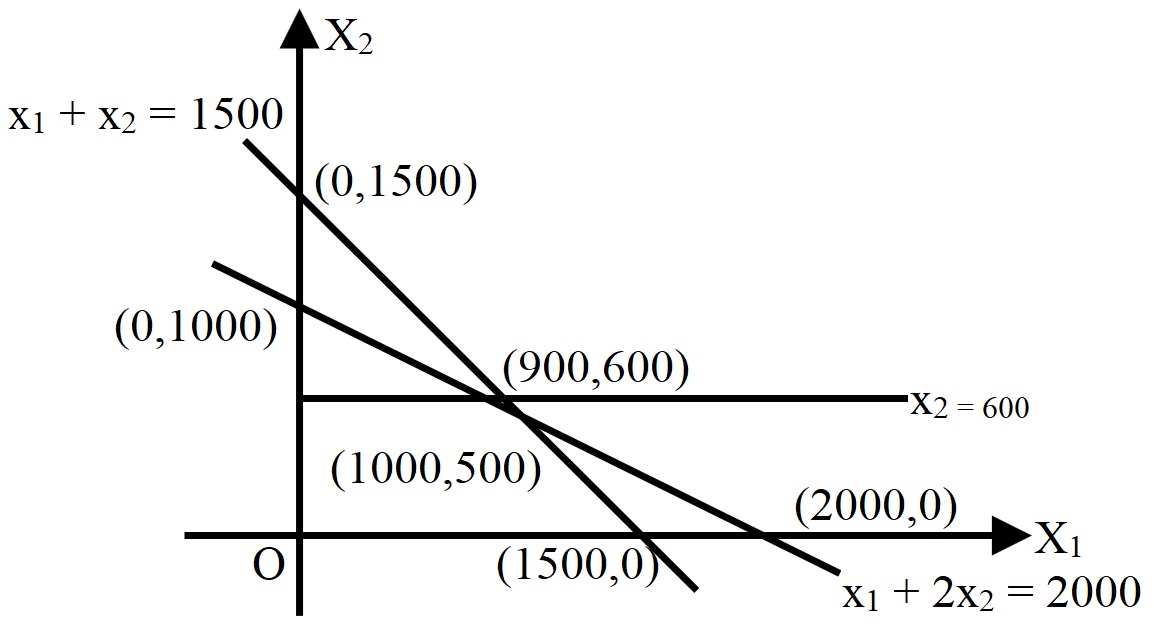
Assertion $(A):$ For the constraints of a $\text{LPP}$ problem given by $\text{x}_1+2\text{x}_2\leq2000,\text{x}_1+\text{x}_2\leq1500,\text{x}_2\leq600$ and $\text{x}_1,\text{x}_2\geq0$ the points $(1000, 0), (0, 500), (2, 0)$ lie in the positive bounded region, but point $(2000, 0)$ does not lie in the positive boundedregion.
Reason $(R):$
Assertion (A) : The lines $\vec{r}=\vec{a}_1+\lambda \vec{b}_1$ and $\vec{r}=\vec{a}_2+\mu \vec{b}_2$ are perpendicular, when $\vec{b}_1 \cdot \vec{b}_2=0$.
Reason (R): The angle $\theta$ between the lines $\vec{r}=\vec{a}_1+\lambda \vec{b}_1$ and $\vec{r}=\vec{a}_2+\mu \vec{b}_2$ is given by $\cos \theta=\frac{\vec{b}_1 \cdot \vec{b}_2}{\left|\vec{b}_1\right|\left|\vec{b}_2\right|}$.