MCQ
$Assertion$: A rigid disc rolls without slipping on a fixed rough horizontal surface with uniform angular velocity. Then the acceleration of lowest point on the disc is zero.
$Reason$ : For a rigid disc rolling without slipping on a fixed rough horizontal surface, the velocity of the lowest point on the disc is always zero
  • A
    If both Assertion and Reason are correct and the Reason is a correct explanation of the Assertion.
  • B
    If both Assertion and Reason are correct but Reason is not a correct explanation of the Assertion.
  • C
    If the Assertion is correct but Reason is incorrect.
  • If the Assertion is incorrect but Reason is correct.
Answer

Correct option: D.
If the Assertion is incorrect but Reason is correct.
d
For a disc rolling without slipping on a horizontal rough surface with uniform angular velocity, the acceleration of lowest point of disc is directed vertically upwards and is not zero (Due to translation part of rolling, acceleration of lowest point is zero. Due to rotational part of rolling, the tangential acceleration of lowest point is zero and centripetal acceleration is non-zero and upwards). Hence Assertion is incorrect.

Need a full question paper?

Generate a complete, print-ready paper with questions like this in minutes — across 16+ boards, with answer keys.

Start Generating Free

Similar questions

Two spheres of different materials one with double the radius and one-fourth wall thickness of the other, are filled with ice. If the time taken for complete melting ice in the large radius one is $25$ minutes and that for smaller one is $16$ minutes, the ratio of thermal conductivities of the materials of larger sphere to the smaller sphere is
A Carnot engine, having an efficiency of $\eta = 1/10$ as heat engine, is used as a refrigerator. If the work done on the system is $10\ J$, the amount of energy absorbed from the reservoir at lower temperature is ....... $J$
An ideal gas is taken through a quasi-static process described by $P = \alpha\, V^2$, with  $\alpha = 5\,atm/m^6$. The gas is expanded to twice its original volume of $1\,m^3$. How much work is done by the expanding gas in this process
A body of mass $5 \,kg$ is moving with a momentum of $10\, kg-m/s$. A force of $0.2 \,N$ acts on it in the direction of motion of the body for $10\, seconds$. The increase in its kinetic energy is ............... $J$
Time period of revolution of a nearest satellite around a planet of radius $R$ is T. Period of revolution around another planet, whose radius is $3R$ but having same density is
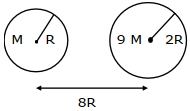
Suppose two planets (spherical in shape) of radii ${R}$ and $2 {R}$, but mass ${M}$ and $9\, {M}$ respectively have a centre to centre separation $8\, {R}$ as shown in the figure. A satellite of mass $'{m}'$ is projected from the surface of the planet of mass $'M'$ directly towards the centre of the second planet. The minimum speed $'v'$ required for the satellite to reach the surface of the second planets is $\sqrt{\frac{a}{7} \frac{G M}{R}}$ then the value of $'a'$ is $....$

[Given: The two planets are fixed in their position]

A rocket of initial mass $6000\, kg$ ejects gases at a constant rate of $16\, kgs^{-1}$ with constant relative speed of $11\, kms^{-1}$ in gravity free space. What is the acceleration of the rocket $1\, min$. after the blast ............ $ m/sec^2$
The standing wave in a medium is expressed as $y=0.2 \sin (0.8 x) \cos (3000 t) \,m$. The distance between any two consecutive points of minimum or maximum displacement is
A bicycle tyre is filled with air having pressure of $270\,kPa$ at $27^{\circ}\,C$. The approximate pressure of the air in the tyre when the temperature increases to $36^{\circ}\,C$ is $............kPa$
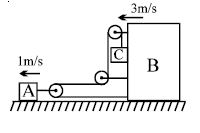
The velocities of $A$ and $B$ are marked in the figure. The velocity of block $C$ is  ......... $m/s$ (assume that the pulleys are ideal and string inextensible)