MCQ
Assertion (A): The Hindu-Arabic number system differs from the international number system due to the fact that it uses 10 digits.
Reason (R): The 10 digits used in the Hindu-Arabic number system are 0, 1, 2, 3, 4, 5, 6, 7. 8 and 9.
  • A
    Both Assertion (A) and Reason (R) are true and Reason (R) is the correct explanation of Assertion (A).
  • B
    Both Assertion (A) and Reason (R) are true and Reason (R) is not the correct explanation of Assertion (A).
  • C
    Assertion (A) is true but Reason (R) is false.
  • Assertion (A) is false but Reason (R) is true.
Answer

Correct option: D.
Assertion (A) is false but Reason (R) is true.
D

Need a full question paper?

Generate a complete, print-ready paper with questions like this in minutes — across 16+ boards, with answer keys.

Start Generating Free

Similar questions

Directions: In the following questions, the Assertions $(A)$ and Reason$(s)$ $(R)$ have been put forward. Read both the statements carefully and choose the correct alternative from the following:
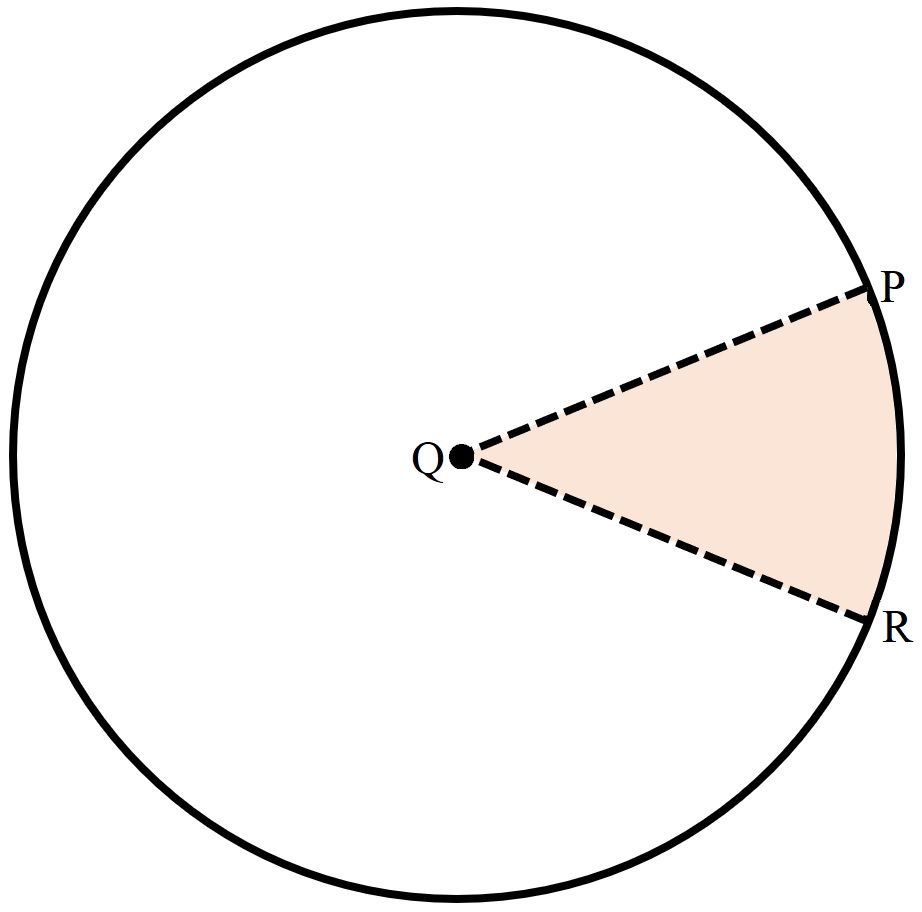
Assertion (A):
 

Reason (R): A region in the interior of a circle enclosed by a chord and an arc is called a segment of the circle.
Directions: In the following questions, the Assertions $(A)$ and Reason(s) $(R)$ have been put forward. Read both the statements carefully and choose the correct alternative from the following: Assertion (A): $10$ paise $= 1$ rupee Reason (R): $1$ rupee $= 100 $paise
Directions: In the following questions, the Assertions $(A)$ and Reason(s) $(R)$ have been put forward. Read both the statements carefully and choose the correct alternative from the following:
Assertion (A): The simplest form of $\frac{12}{20}$ is $\frac{3}{5}$
Reason (R): A fraction is said to be in the simplest (or lowest) form if its numerator and denominator have no common factor except $1$
Directions: In the following questions, the Assertions $(A)$ and Reason(s) $(R)$ have been put forward. Read both the statements carefully and choose the correct alternative from the following:
Assertion (A): There are $15 $ whole numbers between $0$ and $15$
Reason (R): The natural numbers along with zero form the collection of whole numbers
Directions: In the following questions, the Assertions $(A)$ and Reason(s) $(R)$ have been put forward. Read both the statements carefully and choose the correct alternative from the following:
Assertion (A): Perimeter of a square $= 4 \times $ Length of a side
Reason (R): Perimeter is the distance covered along the boundary forming a closedfigure when you go round the figure once
Assertion (A): $\frac{7}{11}$ is a proper fraction.
Reason (R): In a proper fraction numerator is great¬er than the denominator.
Directions: In the following questions, the Assertions $(A)$ and Reason(s) $(R)$ have been put forward. Read both the statements carefully and choose the correct alternative from the following:
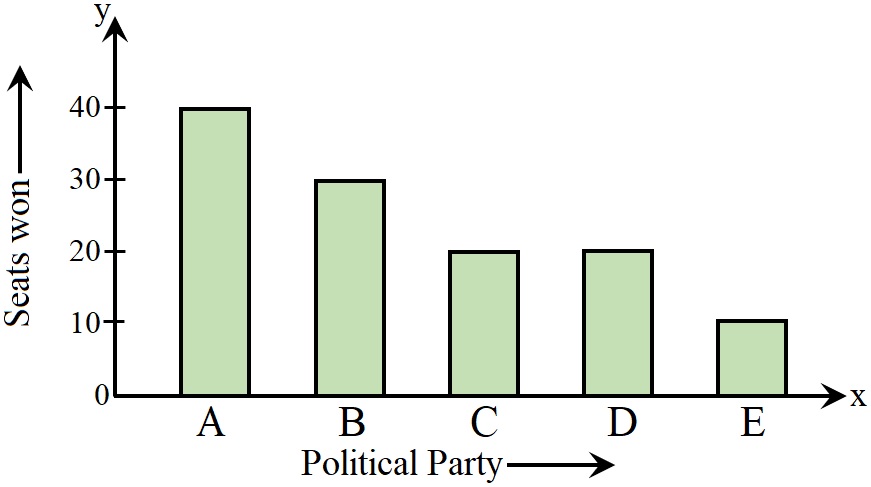
Assertion (A): Observe the following bar graph and consider it as assertions for the next questions:
Reason (R): Only Awon more than $20$ seats
Directions: In the following questions, the Assertions ($A$) and Reason(s) ($R$) have been put forward. Read both the statements carefully and choose the correct alternative from the following:
Assertion ($A$): $67,50,983$ is correct in International System of Numeration
Reason ($R$): $100,000,000$ is the sequence of comma in in International System of Numeration.
Directions: In the following questions, the Assertions $(A)$ and Reason(s) $(R)$ have been put forward. Read both the statements carefully and choose the correct alternative from the following:
Assertion (A): Any point on the perpendicular bisector is equidistant from the endpoints of the line segment.
Reason (R): a line or a segment perpendicular to a segment that passes through the midpoint of the segment
Directions: In the following questions, the Assertions $(A)$ and Reason(s) $(R)$ have been put forward. Read both the statements carefully and choose the correct alternative from the following:
Assertion (A): $0.135=\frac{270}{2000}$
Reason (R): Decimals can be written in fraction form. To convert a decimal to a fraction, place the decimal number over its place value.