Question
Assertion (A) : The line represented by the equation $2 y=-3 x$ passes through the origin.
Reason (R) : Any equation of the form $y=m x+c, c \neq 0$, passes through the origin.
Answer

Self

Need a full question paper?

Generate a complete, print-ready paper with questions like this in minutes — across 16+ boards, with answer keys.

Start Generating Free

Similar questions

Assertion: The number of terms to be taken in the A.P. $9,17,25, \ldots$ So as to make a sum of 636 is 13.
Reason : The sum of first $n$ terms of an A.P. is given by $\frac{n}{2}[2 a+(n-1) d]$.
Assertion (A) : The sequence $2,6,18, \ldots$ is a GP.
Reason (R) : If the numbers $a_1, a_2, a_3, \ldots .$. are in GP, then ccommon ratio of the GP is $\frac{a_1}{a_2}$ or $\frac{a_2}{a_3}$
Assertion (A): When calculating the price paid by the consumer for an item with a known profit percentage, one must include the SGST and CGST to determine the final selling price.
Reason (R): The final selling price includes the profit margin as well as any applicable takes like SGST and CGST.
Assertion : A natural number, when increased by 12 , equals 160 times its reciprocal. The number is 20 .
Reason : The roots of a quadratic equation $a x^2+b x+c=0$ are given by the formula $x=\frac{-b \pm \sqrt{b^2-4 a c}}{2 a}$.
Assertion (A) : The probability that a leap year has 53 Sundays is $\frac{1}{7}$.
Reason (R): A non leap year has 365 days.
Assertion : If the 4th, 10th and 16th terms of a G.P. are $x, y$ and $z$ respectively, then the $x, y, z$ are in G.P.
Reason : The last term of an G.P. is $l=a r^{n-1}$, where $l$ is the last term of an G.P.
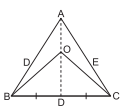
Assertion (A) : In the figure, D is the mid-point of BC . If O lies on AD , then $\mathrm{OB}=\mathrm{OC}$.
Reason (R) : Every point on the perpendicular bisector of a line segment is equidistant from its end points.
Image
Assertion (A) : Mukesh deposits ₹ $ 1000$ per month in a recurring deposit account for $3$ years at $5 \%$ p.a. The maturity value he gets is ₹ $38775$.
Reason (R) : Under Recurring Deposit Scheme, an investor deposits a fixed amount every month for a specified time period.
Assertion (A) : If the points $A (p, 1), B (8,2), C (9,4)$ and $D (7,3)$ are the vertices of a parallelogram, taken in order, then the value of $p$ is 6 .
Reason (R) : Diagonals of a parallelogram bisect each other at right angles.
Assertion (A) : If $\frac{x}{y}=\frac{a}{b}$, then $\frac{x+a}{y+b}=\frac{x-a}{y-b}$
Reason (R) : If $\frac{a}{b}=\frac{c}{d}$, then using componendo and dividendo, we get $\frac{a+b}{a-b}=\frac{c+d}{c-d}$.