MCQ
Assertion (A) : The lines $\vec{r}=\vec{a}_1+\lambda \vec{b}_1$ and $\vec{r}=\vec{a}_2+\mu \vec{b}_2$ are perpendicular, when $\vec{b}_1 \cdot \vec{b}_2=0$.
Reason (R): The angle $\theta$ between the lines $\vec{r}=\vec{a}_1+\lambda \vec{b}_1$ and $\vec{r}=\vec{a}_2+\mu \vec{b}_2$ is given by $\cos \theta=\frac{\vec{b}_1 \cdot \vec{b}_2}{\left|\vec{b}_1\right|\left|\vec{b}_2\right|}$.
  • Both (A) and (R) are true and (R) is the correct explanation of (A).
  • B
    Both (A) and (R) are true but (R) is not the correct explanation of (A).
  • C
    (A) is true but (R) is false.
  • D
    (A) is false but (R) is true.

Answer

Correct option: A.
Both (A) and (R) are true and (R) is the correct explanation of (A).
(a) : If lines are perpendicular, then $\theta=\frac{\pi}{2}$
$
\therefore \quad \cos \frac{\pi}{2}=\frac{\vec{b}_1 \cdot \vec{b}_2}{\left|\vec{b}_1\right| \vec{b}_2 \mid} \Rightarrow \cos \frac{\pi}{2}=\frac{\vec{b}_1 \cdot \vec{b}_2}{\left|\vec{b}_1\right| \vec{b}_2 \mid}
$
$
\Rightarrow \quad \vec{b}_1 \cdot \vec{b}_2=0
$
$\therefore \quad$ Both $A$ and $R$ are true and $R$ is the correct explanation of $A$.

Need a full question paper?

Generate a complete, print-ready paper with questions like this in minutes — across 16+ boards, with answer keys.

Start Generating Free

Similar questions

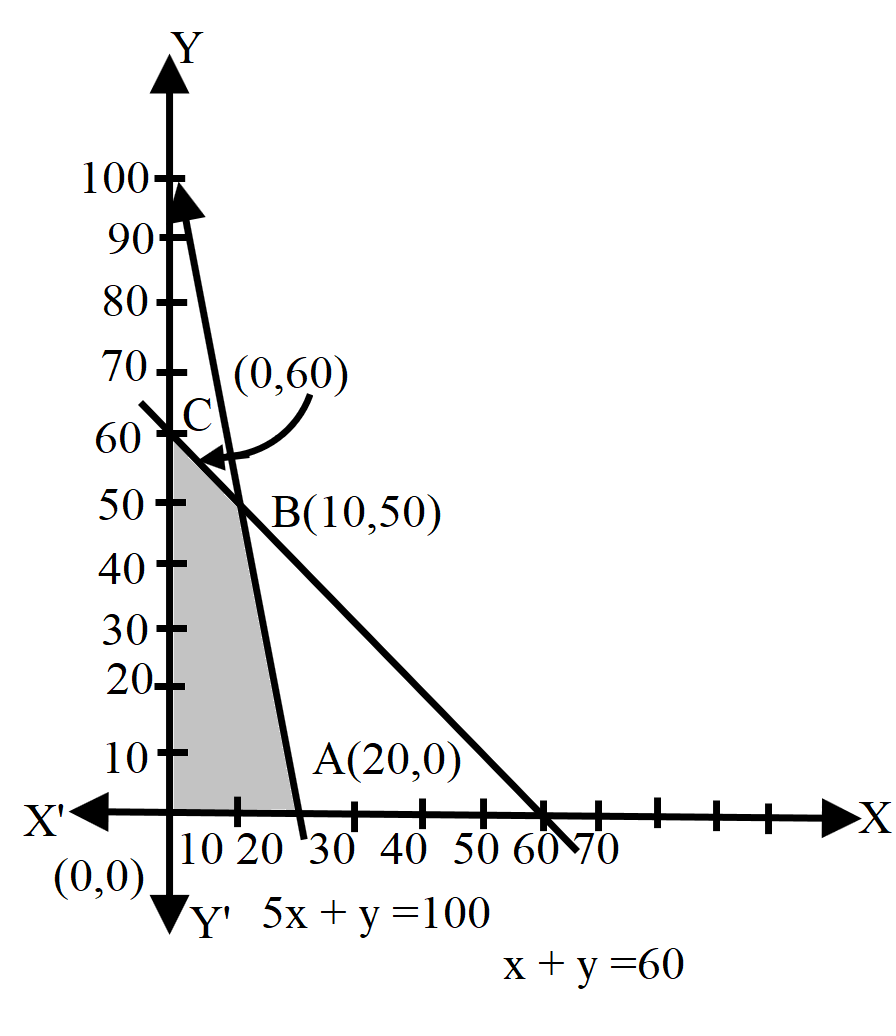
Directions: In the following questions, the Assertions (A) and Reason(s) (R) have been put forward. Read both the statements carefully and choose the correct alternative from the following:

Consider, the graph of constraints stated as linear inequalities as below: $5\text{x}+\text{y}\leq100,\text{x}+\text{y}\leq60,\text{x},\text{y}\geq0.$

Assertion (A): The points (10, 50), (0, 60) , (10, 10) and (20, 0) are feasible solutions.

Reason (R): Points within and on the boundary of the feasible region represent feasible solutions of the constraints.

  1. Both A and R are true and R is the correct explanation of A
  2. Both A and R are true but R is NOT the correct explanation of A
  3. A is true but R is false.
  4. A is false but R is true.
Assertion (A) : Both $\sin x$ and $\cos x$ are decreasing functions in $\left(\frac{\pi}{2}, \pi\right)$.
Reason (R): If a differentiable function decreases in $(a, b)$, then its derivative also decreases in $(a, b)$.
Assertion (A) : The inverse of a matrix $A=\left(\begin{array}{lll}43 & 1 & 6 \\ 35 & 7 & 4 \\ 17 & 3 & 2\end{array}\right)$ does not exist.
Reason (R) : The inverse of singular matrix is not possible.
Assertion (A) : If the cartesian equation of a line is $\frac{x-5}{3}=\frac{y+4}{7}=\frac{z-6}{2}$, then its vector form is $\vec{r}=5 \hat{i}-4 \hat{j}+6 \hat{k}+\lambda(3 \hat{i}+7 \hat{j}+2 \hat{k})$.
Reason (R): The vector equation of line passing through the points $A(\vec{a})$ and parallel to vector $\vec{b}$ is $\vec{r}=\vec{a}-\lambda(\vec{a}-\vec{b})$, where $\lambda \in R$ is a parameter.
Directions: In the following questions, a statement of assertion (A) is followed by a statement of reason (R). Mark the correct choice as:
Assertion: If A is a square matrix such that A2 = I, then (I + A)2 - 3A = I.
Reason: Al = IA = A, where I is Idetity matrix.
  1. Both A and R are true and R is the correct explanation of A.
  2. Both A and R are true but R is not the correct explanation of A.
  3. A is true but R is false.
  4. A is false but R is true.
  5. Both A and R are false.
Directions: In the following questions, a statement of assertion (A) is followed by a statement of reason (R). Mark the correct choice as:
Assertion: If $0<\text{x}\leq\frac{\pi}{2},$ then $\sin^{-1}(\cos\text{x})+\cos^{-1}(\sin\text{x})=\pi-2\text{x}.$
Reason: $\cos^{-1}\text{x}=\frac{\pi}{2}-\sin^{-1}\text{x} $ for all $\text{x}\in[-1,1].$
  1. Both A and R are true and R is the correct explanation of A.
  2. Both A and R are true but R is not the correct explanation of A.
  3. A is true but R is false.
  4. A is false but R is true.
  5. Both A and R are false.
Directions: In the following questions, a statement of assertion (A) is followed by a statement of reason (R). Mark the correct choice as:
Assertion: If X = {0, 1, 2} and the function defined by f(x) = x2 - 2 is surjection then Y = {-2, -1, 0}.
Reason: If f : X → Y is surjective if f(X) = Y.
  1. Both A and R are true and R is the correct explanation of A. 
  2. Both A and R are true but R is not the correct explanation of A.
  3. A is true but R is false.
  4. A is false but R is true.
  5. Both A and R are fals.
Directions: In the following questions, the Assertions (A) and Reason(s) (R) have been put forward. Read both the statements carefully and choose the correct alternative from the following:
Assertion (A) The derivative of $\log\sin\text{x}\text{ w.r.t}\sqrt{\cos\text{x}}$ is $2\sqrt{\cos\text{x}} \cos\text{x } \text{cosec x}$
Reason(R) The derivative of u w.r.t. v is $\frac{\frac{\text{du}}{\text{dx}}}{\frac{\text{dv}}{\text{dx}}}$
  1. Both A and R are true and R is the correct explanation of A
  2. Both A and R are true but R is NOT the correct explanation of A.
  3. A is true but R is false
  4. A is false but R is true
Directions: In the following questions, a statement of assertion (A) is followed by a statement of reason (R). Mark the correct choice as:
Assertion: Domain and Range of a relation R = {{x, y) : x -2y = 0} defined on the set A = {1, 2, 3, 4} are respectively {1, 2, 3, 4} and {2, 4, 6, 8}.
Reason: Domain and Range of a relation R are respectively the sets {$\text{a}:\text{a}\in\text{A}$ and $(\text{a},\text{b})\in\text{R}.$} and {$\text{b}:\text{b}\in\text{A}$ and $(\text{a},\text{b})\in\text{R}.$}
  1. Both A and R are true and R is the correct explanation of A.
  2. Both A and R are true but R is not the correct explanation of A.
  3. A is true but R is false.
  4. A is false but R is true.
  5. Both A and R are fals.
Directions: In the following questions, the Assertions (A) and Reason(s) (R) have been put forward. Read both the statements carefully and choose the correct alternative from the following:
Assertion: Maximum value of z = 11x + 7y, subjectto constraints $2\text{x}+\text{y}\leq6,\text{x}\leq2,\text{x}\geq0,\text{y}\geq0$ will be obtained at (0, 6).
Reason: In a bounded feasible region, it always exist a maximum and minimum value.
  1. A is true, R is true: R is a correct explanation for A.
  2. A is true,R is true; R is not a correct explanation for A.
  3. A is true: R is false.
  4. A is false: R is true.