MCQ
Assertion $(A)$ : The probability that candidates $A$ and $B$ can solve the problem is $\frac{1}{5}$ and $\frac{2}{5},$ then probability that problem will be solved is given by $\frac{12}{25}$.
Reason $(R)$ : If events $A \ B$ are independent, then $P(A \cap B)=P(A) \times P(B)$.
  • A
    Both $(A)$ and $(R)$ are true and $(R)$ is the correct explanation of $(A)$.
  • B
    Both $(A)$ and $(R)$ are true but $(R)$ is not the correct explanation of $(A)$.
  • C
    $(A)$ is true but $(R)$ is false.
  • $(A)$ is false but $(R)$ is true.

Answer

Correct option: D.
$(A)$ is false but $(R)$ is true.
Probability of solving the problem by $A \ B$ is $=1-P\ ($ None of them can solve the problem $)$
$=1-P(\bar{A} \cap \bar{B})=1-P(\bar{A}) \cdot P(\bar{B})$
$=1-[1-P(A)][1-P(B)]$
$=1-\frac{4}{5} \times \frac{3}{5}=\frac{13}{25} .$

Need a full question paper?

Generate a complete, print-ready paper with questions like this in minutes — across 16+ boards, with answer keys.

Start Generating Free

Similar questions

Directions: In the following questions, a statement of assertion (A) is followed by a statement of reason (R). Mark the correct choice as:
Assertion: The minor of the element 3 in the matrix $\begin{bmatrix}2&3&1\\0&-2&4\\2&1&5\end{bmatrix}$ is 8.
Reason: Minor of an element aij of a matrix is the determinant obtained by deleting its $j^{th}$ row and $i^{th}$ column.
Assertion $(A):$ The lines $\vec{r}=\vec{a}_1+\lambda \vec{b}_1$ and $\vec{r}=\vec{a}_2+\mu \vec{b}_2$ are perpendicular, when $\vec{b}_1 \cdot \vec{b}_2=0$.
Reason $(R):$ The angle $\theta$ between the lines $\vec{r}=\vec{a}_1+\lambda \vec{b}_1$ and $\vec{r}=\vec{a}_2+\mu \vec{b}_2$ is given by $\cos \theta=\frac{\vec{b}_1 \cdot \vec{b}_2}{\left|\vec{b}_1\right|\left|\vec{b}_2\right|}$.
Directions: In the following questions, a statement of assertion $(A)$ is followed by a statement of reason $(R)$. Mark the correct choice as:
Assertion: If $\text{A}=\begin{pmatrix}1 & 2 & -1\\ 2 & 0 & 3 \\ -1& 3 & 4 \end{pmatrix},$ then $A^{-1}$ is symmetric matrix.
Reason: If $A$ is symmetric matrix then $A^{-1}$ is symmetric matrix.
Directions: In the following questions, the Assertions $(A)$ and Reason$(s) (R)$ have been put forward. Read both the statements carefully and choose the correct alternative from the following:
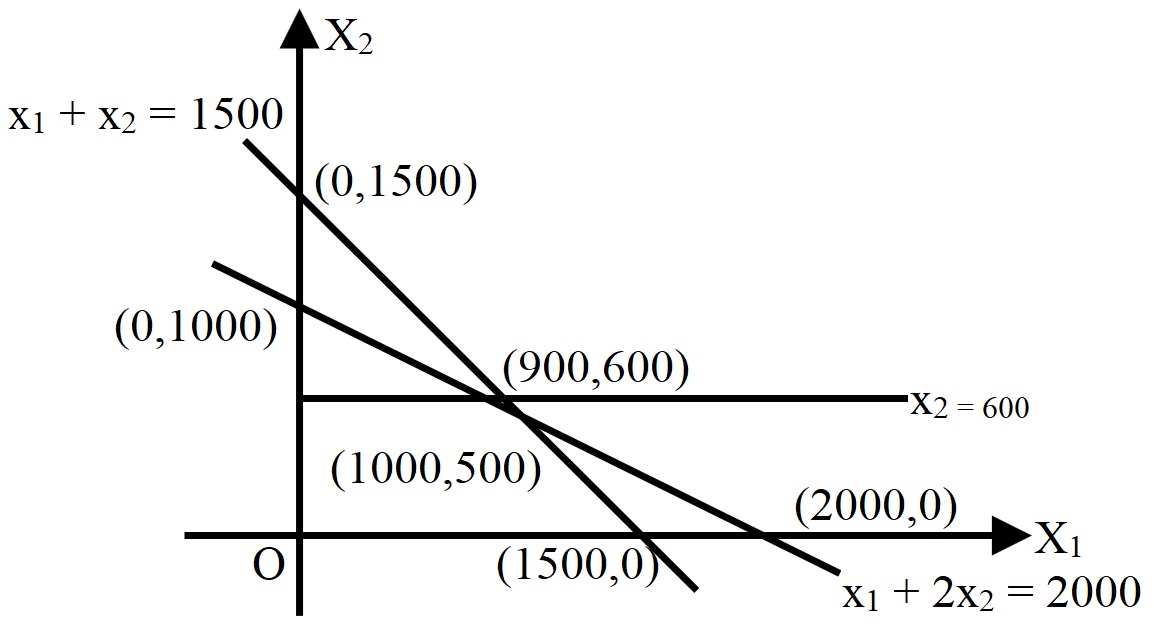
Assertion $(A):$ For the constraints of a $\text{LPP}$ problem given by $\text{x}_1+2\text{x}_2\leq2000,\text{x}_1+\text{x}_2\leq1500,\text{x}_2\leq600$ and $\text{x}_1,\text{x}_2\geq0$ the points $(1000, 0), (0, 500), (2, 0)$ lie in the positive bounded region, but point $(2000, 0)$ does not lie in the positive boundedregion.
Reason $(R):$
Directions : In the following questions, the Assertions $(A)$ and Reason $(s)\ (R)$ have been put forward. Read both the statements carefully and choose the correct alternative from the following :
Assertion $(A) : $ The function $y = [ x(y^2)]^2$ is increasing in $(0,1)\cup(2,\infty)$
Reason $(R) : \frac{\text{dy}}{\text{dx}}=0,$ when $\text{x}=0,1,2.$
Assertion (A) : The inverse of the matrix $\left[\begin{array}{ccc}1 & 3 & 5 \\ 2 & 6 & 10 \\ 9 & 8 & 7\end{array}\right]$ does not exist.
Reason (R) : The matrix $\left[\begin{array}{ccc}1 & 3 & 5 \\ 2 & 6 & 10 \\ 9 & 8 & 7\end{array}\right]$ is singular.
Assertion $(A) :$ If the points $\vec{P}=(\vec{a}+\vec{b}-\vec{c})$, $\vec{Q}=(2 \vec{a}+\vec{b})$ and $\vec{R}=(\vec{b}+t \vec{c})$ are collinear, where $\vec{a}, \vec{b}, \vec{c}$ are three non$-$coplanar vectors, then the value of $t$ is $-2 .$
Reason $(R) :$ If $P, Q, R$ are collinear, then
$\overrightarrow{P Q} \| \overrightarrow{P R} \text { or } \overrightarrow{P Q}=\lambda \overrightarrow{P R}, \lambda \in R$
Assertion $(A) :$ Let $f: R \rightarrow R$ be a function such that $f(x)=x^3+x^2+3 x+\sin x$. Then, $f$ is an increasing function.
Reason $(R) :$ If $f^{\prime}(x) < 0$, then $f(x)$ is a decreasing function.
Directions : In the following questions, a statement of assertion $(A)$ is followed by a statement of reason $(R).$ Mark the correct choice as :
Assertion : If $n(A) = p$ and $n(B) = q$ then the number of relations from $A$ to $B$ is $2^{pq}$.
Reason : A relation from $A$ to $B$ is a subset of $A \times B.$
Directions : In the following questions, the Assertions $(A)$ and Reason $(s)\ (R)$ have been put forward. Read both the statements carefully and choose the correct alternative from the following:
Assertion $(A) :$ The derivative of $\log\sin\text{x}\text{ w.r.t}\sqrt{\cos\text{x}}$ is $2\sqrt{\cos\text{x}} \cos\text{x } \text{cosec x}$
Reason $(R) :$ The derivative of $\text{u w.r.t. v}$ is $\frac{\frac{\text{du}}{\text{dx}}}{\frac{\text{dv}}{\text{dx}}}$