MCQ
Assertion (A) : Three points with position vectors $\vec{a}, \vec{b}$ and $\vec{c}$ are collinear if $\vec{a} \times \vec{b}+\vec{b} \times \vec{c}+\vec{c} \times \vec{a}=\overrightarrow{0}$
Reason (R): If $\overrightarrow{A B} \cdot \overrightarrow{A C}=0$, then $\overrightarrow{A B} \perp \overrightarrow{A C}$.
  • A
    Both (A) and (R) are true and (R) is the correct explanation of (A).
  • Both (A) and (R) are true but (R) is not the correct explanation of (A).
  • C
    (A) is true but (R) is false.
  • D
    (A) is false but (R) is true.

Answer

Correct option: B.
Both (A) and (R) are true but (R) is not the correct explanation of (A).
(b) : If $A, B, C$ are collinear, then $\overrightarrow{A B}=k \overrightarrow{A C}$
$
\begin{array}{l}
\therefore \overrightarrow{A B} \times \overrightarrow{A C}=\overrightarrow{0} \Rightarrow(\vec{b}-\vec{a}) \times(\vec{c}-\vec{a})=\overrightarrow{0} \\
\Rightarrow \vec{b} \times \vec{c}+\vec{a} \times \vec{b}+\vec{c} \times \vec{a}=\overrightarrow{0} \text { i.e., } \vec{a} \times \vec{b}+\vec{b} \times \vec{c}+\vec{c} \times \vec{a}=\overrightarrow{0}
\end{array}
$
Hence, both assertion and reason are true but reason is not the correct explanation of assertion.

Need a full question paper?

Generate a complete, print-ready paper with questions like this in minutes — across 16+ boards, with answer keys.

Start Generating Free

Similar questions

Assertion (A) : The value of$\int_{-3}^3\left(a x^5+b x^3+c x+k\right) d x,$ where $a, b, c, k$ are constants, depends on only $k$.
Reason (R) : $\int_{-a}^a f(x) d x=0$, if $f(-x)=-f(x)$ i.e., $f$ is an odd function.
Assertion (A) : $y=a \sin x+b \cos x$ is a general solution of $y^{\prime \prime}+y=0$.
Reason (R): $y=a \sin x+b \cos x$ is a trigonometric function.
Assertion (A): The area bounded by the parabola $y^2=4 a x$ and the line $x=a$ and $x=4 a$ is $\frac{56 a^2}{3}$ sq. units.
Reason (R) : The area bounded by the parabola $y^2=49 x$ and $y=m x$ is $8 a^2 / 3 m^3$ sq. units.
Directions: In the following questions, a statement of assertion (A) is followed by a statement of reason (R). Mark the correct choice as:
Assertion: $(\text{A}+\text{B})^{2}\neq\text{A}^{2}+2\text{AB}+\text{B}^{2}.$
Reason: Generally AB = BA.
  1. Both A and R are true and R is the correct explanation of A.
  2. Both A and R are true but R is not the correct explanation of A.
  3. A is true but R is false.
  4. A is false but R is true.
  5. Both A and R are false.
Directions: In the following questions, the Assertions (A) and Reason(s) (R) have been put forward. Read both the statements carefully and choose the correct alternative from the following:
Assertion (A): The linear programming problem, maximize Z = x + 2y subject to constraints $\text{x}-\text{y}\leq10,2\text{x}+3\text{y}\leq20$ and $\text{x}\geq0; \text{y}\geq0.$ It gives the maximum value of Z as $\frac{40}{3}.$
Reason (R): To obtain maximum value of Z, we need to compare value of Z at all the corner points of the shaded region.
  1. Both A and R are true and R is the correct explanation of A
  2. Both A and R are true but R is NOT the correct explanation of A
  3. A is true but R is false.
  4. A is false but R is true.
Directions: In the following questions, a statement of assertion (A) is followed by a statement of reason (R). Mark the correct choice as:
Assertion: A, B are two sets such that n(A) = p and n(B) = q, The number of functions from A onto B is qp ..
Reason: Every function is a relation.
  1. Both A and R are true and R is the correct explanation of A. 
  2. Both A and R are true but R is not the correct explanation of A.
  3. A is true but R is false.
  4. A is false but R is true.
  5. Both A and R are fals.
Directions: In the following questions, a statement of assertion (A) is followed by a statement of reason (R). Mark the correct choice as:
Assertion: $\tan^{-1}\text{x}+\tan^{-1}\big(\frac{1}{\text{x}}\big)=\frac{\pi}{2}.$
Reason: $\tan^{-1}\text{x}+\cot^{-1}\text{x}=\frac{\pi}{2}$ for all $\text{x}\in\text{R}.$
  1. Both A and R are true and R is the correct explanation of A.
  2. Both A and R are true but R is not the correct explanation of A.
  3. A is true but R is false.
  4. A is false but R is true.
  5. Both A and R are false. 
Directions: In the following questions, the Assertions (A) and Reason(s) (R) have been put forward. Read both the statements carefully and choose the correct alternative from the following:

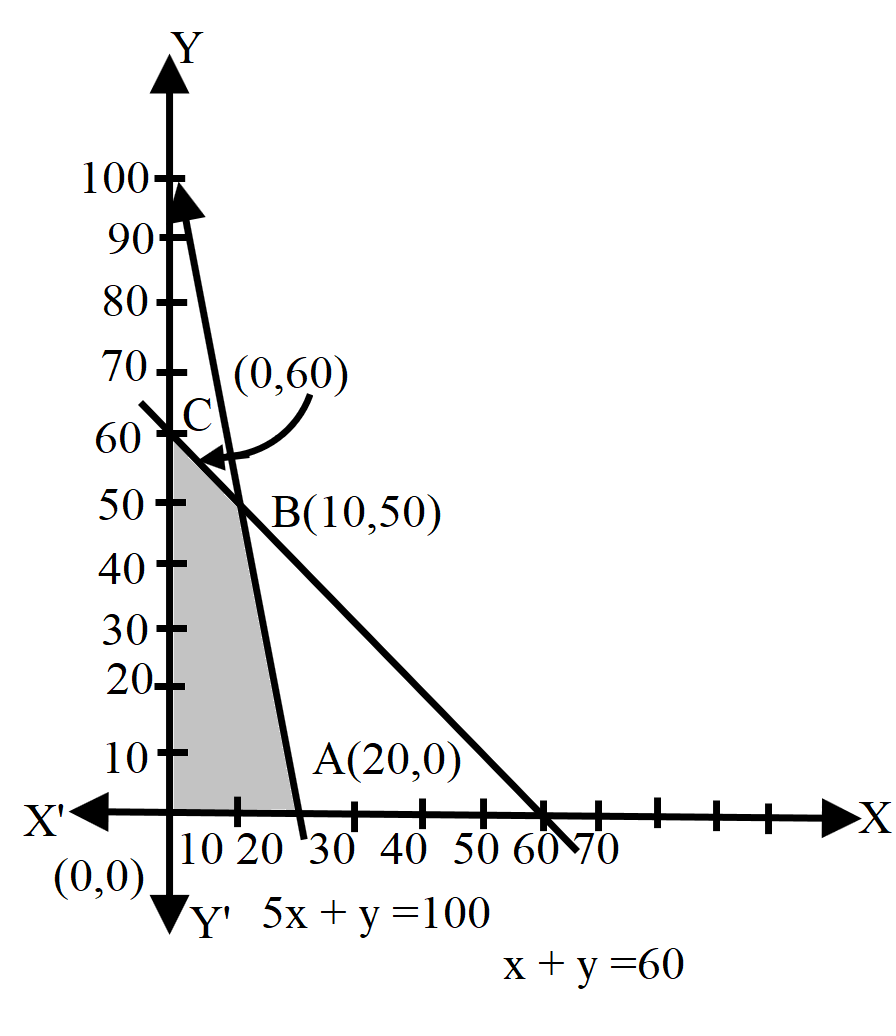
Consider, the graph of constraints stated as linear inequalities as below: $5\text{x}+\text{y}\leq100,\text{x}+\text{y}\leq60,\text{x},\text{y}\geq0.$

Assertion (A): The points (10, 50), (0, 60) , (10, 10) and (20, 0) are feasible solutions.

Reason (R): Points within and on the boundary of the feasible region represent feasible solutions of the constraints.

  1. Both A and R are true and R is the correct explanation of A
  2. Both A and R are true but R is NOT the correct explanation of A
  3. A is true but R is false.
  4. A is false but R is true.
Directions: In the following questions, a statement of assertion (A) is followed by a statement of reason (R). Mark the correct choice as:
Assertion: The equation of the line joining (1, 2) and (3, 6) using determinants is y = 3x.
Reason: The area of $\triangle\text{PAB}$ is zero if P(x, y) is a point on the line joining a A and B.
  1. Both A and R are true and R is the correct explanation of A.
  2. Both A and R are true but R is not the correct explanation of A.
  3. A is true but R is false.
  4. A is false but R is true.
  5. Both A and R are false.
Assertion (A): Let $f(x)=x^3+a x^2+b x+5 \sin ^2 x$, then the condition that $f(x)$ is always one-one function is $a^2-3 b+15<0$.
Reason (R) : $f(x)$ to be one one either $f$ is strictly increasing or strictly decreasing.