MCQ
$Assertion :$ A transverse waves are produced in a very long string fixed at one end. Only progressive wave is observed near the free end.
$Reason :$ Energy of reflected wave does not reach the free end.
  • If both Assertion and Reason are correct and the Reason is a correct explanation of the Assertion.
  • B
    If both Assertion and Reason are correct but Reason is not a correct explanation of the Assertion.
  • C
    If the Assertion is correct but Reason is incorrect.
  • D
    If both the Assertion and Reason are incorrect.
Answer

Correct option: A.
If both Assertion and Reason are correct and the Reason is a correct explanation of the Assertion.
a

Need a full question paper?

Generate a complete, print-ready paper with questions like this in minutes — across 16+ boards, with answer keys.

Start Generating Free

Similar questions

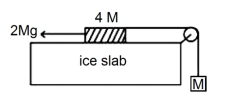
A hanging mass $M$ is connected to a four times bigger mass by using a string-pulley arrangement. as shown in the figure. The bigger mass is placed on a horizontal ice-slab and being pulled by $2\,Mg$ force. In this situation. tension in the string is $\frac{x}{5}$ $Mg$ for $x =$ Neglect mass of the string and friction of the block (bigger mass) with ice slab. (Given $g=$ acceleration due to gravity)
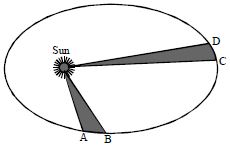
The fig. shows the motion of a planet around the un in an elliptical orbit with sun at the  focus. The shaded areas can be assumed to be equal. If $t_1$ and $t_2$ represent the  time taken for the planet to move from $A$ to $B$ and $C$ to $D$ respectively, then
A ball is thrown from the location $\left(x_0, y_0\right)=(0,0)$ of a horizontal playground with an initial speed $v_0$ at an angle $\theta_0$ from the $+x$-direction. The ball is to be hit by a stone, which is thrown at the same time from the location $\left(x_1, y_1\right)=(L, 0)$. The stone is thrown at an angle $\left(180-\theta_1\right)$ from the $+x$-direction with a suitable initial speed. For a fixed $v_0$, when $\left(\theta_0, \theta_1\right)=\left(45^{\circ}, 45^{\circ}\right)$, the stone hits the ball after time $T_1$, and when $\left(\theta_0, \theta_1\right)=\left(60^{\circ}, 30^{\circ}\right)$, it hits the ball after time $T_2$. In such a case, $\left(T_1 / T_2\right)^2$ is. . . . .
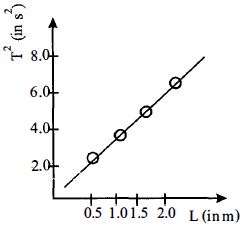
In an experiment for determining the gravitational acceleration $g$ of a place with the help of a simple pendulum, the measured time period square is plotted against the string length of the pendulum in the figure. What is the value of $g$ at the place? ...... $m/s^2$
If force on a rocket having exhaust velocity of $300 \,m/sec$ is $210\, N$, then rate of combustion of the fuel is ........... $kg/s$
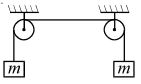
Two identical mass $m$ are connected to a massless string which is hung over two frictionless pulleys as shown in figure. If everything is at rest, what is the tension in the cord?
The weight of an object in the coal mine, sea level, at the top of the mountain are ${W_1},\;{W_2}$ and ${W_3}$ respectively, then
 A small speaker delivers $2\, W$ of audio output. At what distance from the speaker will one detect $120\, dB$ intensity sound ... $cm$ ? [Given reference intensity of sound as $10^{-12}\,W/m^2$]
A long cylindrical glass vessel has a small hole of radius r at its bottom. The depth to which the vessel can be lowered vertically in a deep water bath (surface tension T) without any water entering inside is:
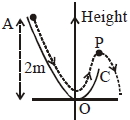
A particle $(\mathrm{m}=1\; \mathrm{kg})$ slides down a frictionless track $(AOC)$ starting from rest at a point $A$ (height $2\; \mathrm{m}$ ). After reaching $\mathrm{C}$, the particle continues to move freely in air as a projectile. When it reaching its highest point $P$ (height $1 \;\mathrm{m}$ ). the kinetic energy of the particle (in $\mathrm{J}$ ) is : (Figure drawn is schematic and not to scale; take $\left.g=10 \;\mathrm{ms}^{-2}\right)$