MCQ
Assertion (A): Two decimal numbers having different whole-number parts cannot be compared.
Reason (R): In order to compare two decimal numbers we first convert them to like decimals.
  • A
    Both Assertion (A) and Reason $(R)$ are true and Reason $(R)$ is the correct explanation OF Assertion (A).
  • B
    Both Assertion $(A)$ and Reason $(R)$ are true and Reason $(R)$ is not the correct explanation of Assertion (A).
  • C
    Assertion (A) is true but Reason (R) is false.
  • Assertion (A) is false but Reason (R) is true.
Answer

Correct option: D.
Assertion (A) is false but Reason (R) is true.
(d): Any two decimal numbers can be compared.
$\therefore A$ is false.
The first step towards comparison of two decimal numbers is their conversion into like decimals. $\therefore R$ is true.

Need a full question paper?

Generate a complete, print-ready paper with questions like this in minutes — across 16+ boards, with answer keys.

Start Generating Free

Similar questions

Assertion (A): 36 minutes expressed as a percentage of a day is $2.5 \%$.
Reason (R): There are 1440 minutes in a day.
Assertion (A): When two straight lines intersect, two pairs of vertically opposite angles are formed.
Reason (R): Vertically opnosite anoles are alwavs sumplementary.
Directions: In the following questions, the Assertions $(A)$ and Reason$(s)$ $(R)$ have been put forward. Read both the statements carefully and choose the correct alternative from the following:
Assertion: The base of a prism is any shape.
Reasons: A prism is a $3-$dimensional shape with two identical shapes facing each other.
Directions: In the following questions, the Assertions $(A)$ and Reason$(s)$ $(R)$ have been put forward. Read both the statements carefully and choose the correct alternative from the following:
Assertion: When the selling price exceeds the cost price in a transaction, we have made a profit (gain).
Reason: Profit=sellingprice–costprice.
Directions: In the following questions, the Assertions $(A)$ and Reason$(s)$ $(R)$ have been put forward. Read both the statements carefully and choose the correct alternative from the following:
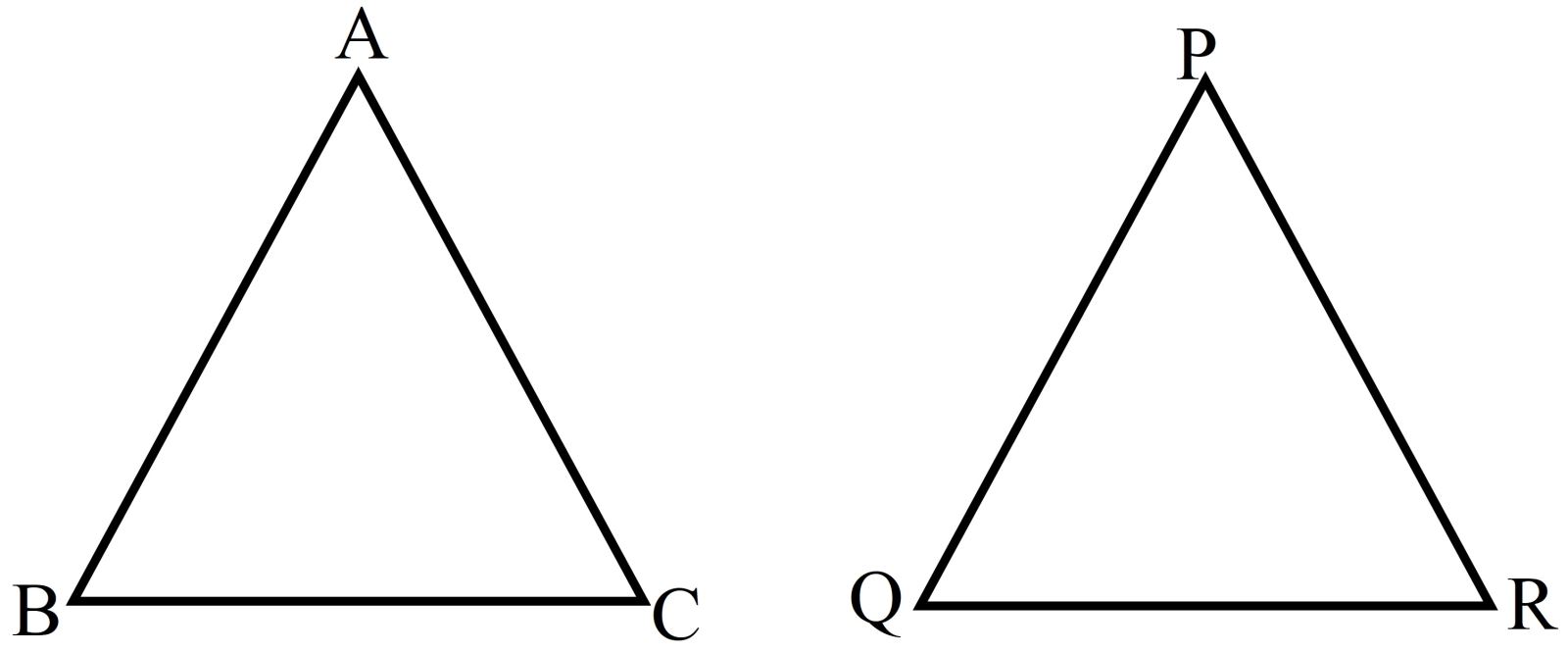
Assertion: In $\triangle\text{ABC}$ and $\triangle\text{PQR}$, $AB = PQ, AC = PR$ and $\triangle\text{PQR} = \angle\text{QPR} $ then $\triangle\text{ABC} = \triangle\text{PQR}$
Reason: Both the triangles are congruent by $SSS$ congruence.
Directions: In the following questions, the Assertions $(A)$ and Reason$(s)$ $(R)$ have been put forward. Read both the statements carefully and choose the correct alternative from the following:
Assertion: The complement of $15^\circ $ is $75^\circ $
Reason: Two angles are said to be complementary if the sum of their measures is $90^\circ $.
Directions: In the following questions, the Assertions $(A)$ and Reason$(s) (R)$ have been put forward. Read both the statements carefully and choose the correct alternative from the following:
Assertion: While dividing a fraction by another fraction, we multiply the first fraction by the reciprocal of the other fraction.
Reason: $\frac{1}{22}\div\frac{3}{76}=\frac{1}{22}\times\frac{76}{3}$
Directions: In the following questions, the Assertions $(A)$ and Reason$(s)$ $(R)$ have been put forward. Read both the statements carefully and choose the correct alternative from the following:
Assertion: Two angles measures $a - 60^\circ $ and $123^\circ - 2a$. If each one is opposite to equal sides of an isosceles triangle, then the value of a is $61^\circ $.
Reason: Sides opposite to equal angles of a triangle are equal.
Directions: In the following questions, the Assertions $(A)$ and Reason$(s)$ $(R)$ have been put forward. Read both the statements carefully and choose the correct alternative from the following:
Assertion: to compare two quantities unit must be same.
Reason: comparison can be done of only some quantities.
Assertion (A) Product of two fractions $ =\frac{\text { Product of their numerators }}{\text { Product of their denominators }} $
Reason (R) $\frac{56}{63}=\frac{7 \times 8}{9 \times 7}$