MCQ
Assertion (A): Whole numbers are not closed under division
Reason (R): A rational number is a number that is in the form of $\frac{\text{p}}{\text{q}}$ where p and q are integers, and q is not equal to 0.
  • A
    Both A and R are true and R is the correct explanation of A
  • Both A and R are true but R is not the correct explanation of A
  • C
    A is true but R is false
  • D
    A is false but R is true

Answer

Correct option: B.
Both A and R are true but R is not the correct explanation of A
B

Need a full question paper?

Generate a complete, print-ready paper with questions like this in minutes — across 16+ boards, with answer keys.

Start Generating Free

Similar questions

Directions: In the following questions, the Assertions $(A)$ and Reason(s) $(R)$ have been put forward. Read both the statements carefully and choose the correct alternative from the following:
Assertion (A): All the parallelograms are rectangles
Reason (R): All the rhombuses are parallelograms.
Directions: In the following questions, the Assertions $(A)$ and Reason(s) $(R)$ have been put forward. Read both the statements carefully and choose the correct alternative from the following:
Assertion (A): Equilateral triangle is a regular polygon with $3$ sides.
Reason (R): a polygon that is equiangular (all angles are equal in measure) and equilateral (all sides have the same length)
Directions: In the following questions, the Assertions $(A)$ and Reason(s) $(R)$ have been put forward. Read both the statements carefully and choose the correct alternative from the following:
Assertion (A): The factorisation of $a^3+a^2 b+a b^2$ is a $\left(a^2+a b+b^2\right)$
Reasons (R): The factorisation is defined as expressing or decomposing a number or an algebraic expression as a product of its prime factors or irreducible factors.
Directions: In the following questions, the Assertions $(A)$ and Reason(s) $(R)$ have been put forward. Read both the statements carefully and choose the correct alternative from the following:
Assertion (A): One angle of a parallelogram is a right angle. The name of the quadrilateral is rectangle.
Reason (R): a rectangle is a quadrilateral with four right angles
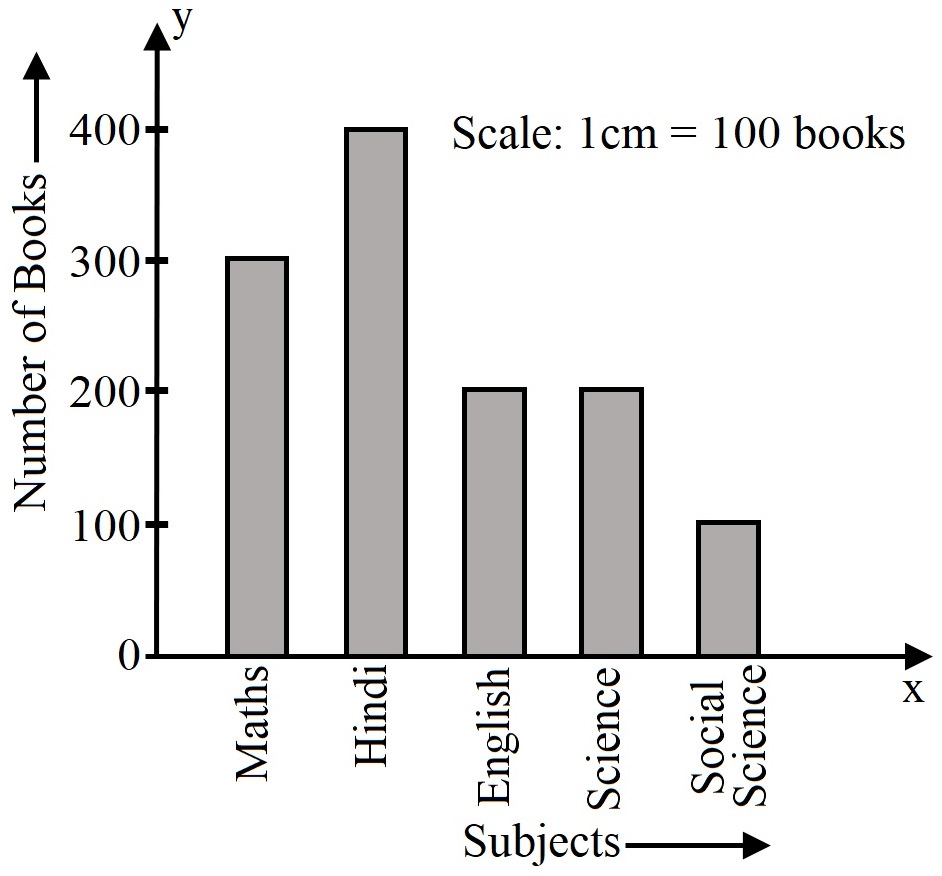
Assertions (A): Hindi have maximum books.
Observe the figure as reasons for the following assertions:
Assertion (A): 10 men can dig a trench in 15 days. Then in 55 days 3 men take to dig a trench.
Reasons (R): A direct proportion shows the direct the relation between two quantities. An inverse proportion shows inverse or indirect relation between two quantities.
Directions: In the following questions, the Assertions $(A)$ and Reason(s) $(R)$ have been put forward. Read both the statements carefully and choose the correct alternative from the following:
Assertion (A): The factorisation of $x^2 y^2+x y+x y^2 z+y z+x^2 y z+x z$ is $(x y+y z+z x)(z x+1)$
Reasons (R): The factorisation is defined as expressing or decomposing a number or an algebraic expression as a product of its prime factors or irreducible factors.
Assertion (A): $\left[(-1)^3 \times 2^3 \times(-3)^3 \times 4^3\right]$ is a positive number.
Reason (R): The cube of a negative number is negative while that of a positive number is positive.
Directions: In the following questions, the Assertions $(A)$ and Reason$(s) (R)$ have been put forward. Read both the statements carefully and choose the correct alternative from the following:
Assertion $(A)$: The ratio $4 : 2$5 converted to percentage is $18\%$
Reasons $(R)$: A ratio can be defined as the relationship or comparison between two numbers of the same unit to check how bigger is one number than the other one.
Assertion (A): The largest number of the three consecutive numbers is x + 1. Then, the smallest number is x - 1.
Reason (R): The value of the variable which makes left hand side equal to right hand side in the given equation is called the solution or the root of the equation.