MCQ
$Assertion$ : An astronaut experience weightlessness in a space satellite.

$Reason$ : When a body falls freely it does not experience gravity

  • If both Assertion and Reason are correct and the Reason is a correct explanation of the Assertion.
  • B
    If both Assertion and Reason are correct but Reason is not a correct explanation of the Assertion.
  • C
    If the Assertion is correct but Reason is incorrect.
  • D
    If both the Assertion and Reason are incorrect.
Answer

Correct option: A.
If both Assertion and Reason are correct and the Reason is a correct explanation of the Assertion.
a
When a body falls freely its accelerating force is g thus apparent weight of body $= M\,(g -g)$ is zero. Hence astronaut falling freely in space experiences weightlessness as its gravitational force is counter balanced by centripetal force of satellite

Need a full question paper?

Generate a complete, print-ready paper with questions like this in minutes — across 16+ boards, with answer keys.

Start Generating Free

Similar questions

A satellite of mass $200 \,kg$ revolves around a planet of mass $5 \times 10^{30} \,kg$ in a circular orbit of radius $6.6 \times 10^6 \,m$. Binding energy of the satellite is .............. $J$
A ball is projected horizontally with a speed $v$ from the top of inclined an plane which is  inclined at an angle $45^o$ with the horizontal. How far from the point of projection will  the ball strike the plane ?
If $v$ is the velocity of a body moving along $x$-axis, then acceleration of body is .........
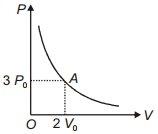
The variation of pressure $P$ with volume $V$ for an ideal monatomic gas during an adiabatic process is shown in figure. At point $A$ the magnitude of rate of change of pressure with volume is
The equation of a light wave is written as $\text{y}=\text{A}\ \sin(\kappa\text{x}-\omega\text{t}).$ Here, y represents:
  1. Displacement of either particles.
  2. Pressure in the medium.
  3. Density of the medium.
  4. Electric field.
Under which of the following conditions is the law $PV = RT$ obeyed most closely by a real gas
The temperature at which a black body of unit area loses its energy at the rate of $1$ joule/second is
A cubical block of mass M and edge a slides down a rough inclined plane of inclination $\theta$ with a uniform velocity. The torque of the normal force on the block about its centre has a magnitude:

  1. $\text{Zero.}$

  2. $\text{Mga}$

  3. $\text{Mga}\sin\theta$

  4. $\frac{1}{2}\text{Mga}\sin\theta$

A particle moves with a constant velocity parallel to the X-axis. Its angular momentum with respect to the origin:
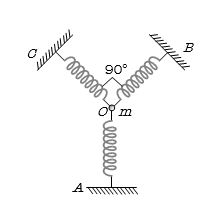
A particle of mass $m$ is attached to three identical springs $A, B$ and $C$ each of force constant $ k$ a shown in figure. If the particle of mass $m$ is pushed slightly against the spring $A$ and released then the time period of oscillations is