Assertion : An electric bulb becomes dim, when the electric heater in parallel circuit is switched on.
Reason : Dimness decreases after sometime.
AIIMS 2008, Easy
Download our app for free and get started
The electric power of a heater is more than that of a bulb. As $P\, \propto \,\frac{1}{R}$, the resistance of heater is less than that of the electric bulb. When a heater connected in parallel to the bulb is switched on, it draws more current due to its lesser resistance, consequently, the current through the bulb decreases and so it becomes dim. When the heater coil becomes sufficient hot, its resistance becomes more and hence it draws a little lesser current. Consequently, the current through the electric bulb recovers.

Download our appand get started for free
Experience the future of education. Simply download our apps or reach out to us for more information. Let's shape the future of learning together!No signup needed.*
Similar Questions
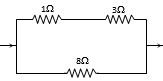
- 1Power dissipated across the $8 \,\,\Omega$ resistor in the circuit shown here is $2\,\, watt.$ The power dissipated in watt units across the $3 \,\,\Omega$ resistor isView Solution
- 2A steady current $I$ flows through a wire of radius $r$, length $L$ and resistivity $\rho$. The current produces heat in the wire. The rate of heat loss in a wire is proportional to its surface area. The steady temperature of the wire is independent ofView Solution
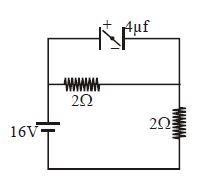
- 3What is net force on the small dipole placed inside the capacitor at steady state if the plates are separated by $1\ cm$ ?......$N$View Solution
- 4A current through a wire depends on time as $i =\alpha_{0} t +\beta t ^{2}$ where $\alpha_{0}=20 A / s$ and $\beta=8 As ^{-2} .$ Find the charge crossed through a section of the wire in $15 \,s$ (in $C$)View Solution
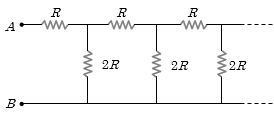
- 5An infinite ladder network is arranged with resistances $R$ and $2 R$ as shown. The effective resistance between terminals $A$ and $B$ isView Solution
- 6A certain piece of silver of given mass is to be made like a wire. Which of the following combination of length $(L)$ and the area of cross-sectional $(A) $ will lead to the smallest resistanceView Solution
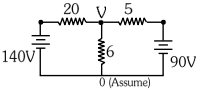
- 7The value of current in the $6 \,\Omega$ resistance is $....\,A$View Solution
- 8The ammeter reading in the circuit below is .............. $A$View Solution
- 9View SolutionA potentiometer is an ideal device of measuring potential difference because
- 10Masses of $3$ wires of same metal are in the ratio $1 : 2 : 3$ and their lengths are in the ratio $3 : 2 : 1$. The electrical resistances are in ratioView Solution