Question
Assertion :   An electron is not deflected on passing through certain region of space. This observation confirms that there is no magnetic field in that region.
Reason     : The deflection of electron depends on angle between velocity of electron and direction of magnetic field. (a) If both assertion and reason are true and the reason is the correct explanation of the assertion.(b) If both assertion and reason are true but reason is not the correct explanation of the assertion.(c) If assertion is true but reason is false.(d) If assertion is false but reason is true.


Answer

(d) If assertion is false but reason is true.
Need a full question paper?

Generate a complete, print-ready paper with questions like this in minutes — across 16+ boards, with answer keys.

Start Generating Free

Similar questions

Which of the following combinations should be selected for better tuning of an LCR circuit used for communication?
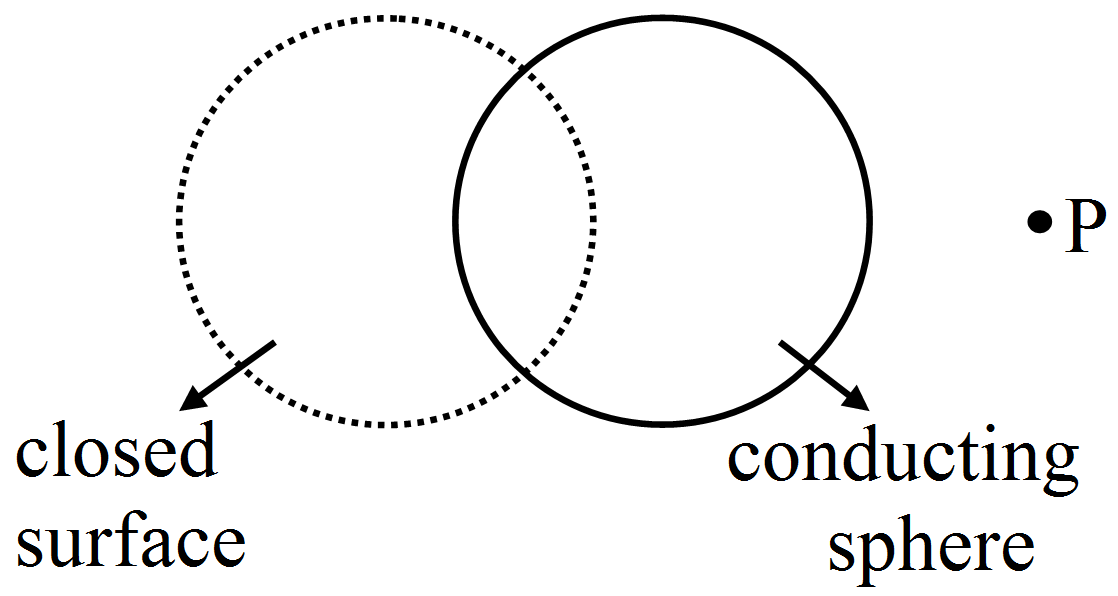
Figure shows a closed surface which intersects a conducting sphere. If a positive charged is placed at the point P, the flux of the electic field through the closed surface:
  1. Will remain zero.
  2. Will become positive.
  3. Will become neagative.
  4. Will become undefined.
One of the following wavelengths is absent and the rest are present in the X-rays coming from a Coolidge tube. Which one is the absent wavelength?
The time taken by sunlight to cross a $5\ mm$ thick glass plate $(\mu = 3/2)$ is
The distance of the eye-lens from the retina is x. For a normal eye, the maximum focal length of the eye-lens:
  1. = x.
  2. < x.
  3. > x.
  4. = 2x.
A piece of cloud having area $25 \times 10^6 m^2$ and electric potential of $10^5$ volts. If the height of cloud is $0.75 \ km,$ then energy of electric field between earth and cloud will be
Assertion  :   X-rays can penetrate through the flesh but not through the bones.
Reason      : The penetrating power of X-rays depends on voltage.(a) If both assertion and reason are true and the reason is the correct explanation of the assertion.(b) If both assertion and reason are true but reason is not the correct explanation of the assertion.(c) If assertion is true but reason is false.(d) If the assertion and reason both are false.


A spectrum is formed by a prism of dispersive power ‘ω’. If the angle of deviation is ‘δ’, then the angular dispersion is(a) ω/δ    (b) δ / ω (c) 1/ ωδ (d) ω δ
       
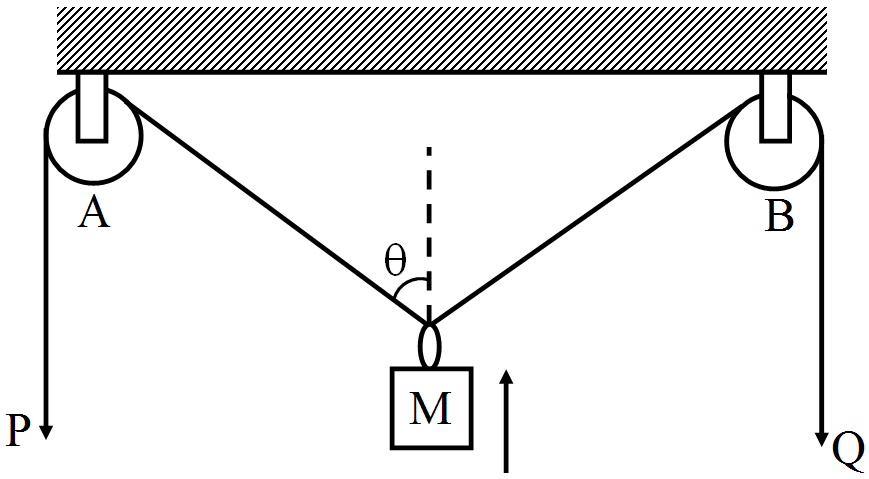
In the arrangement shown in figure, the ends P and Q of an inextensible string move downwards with uniform speed u. Pulleys A and B are fixed. The mass M moves upwards with a speed:
  1. $2\text{u}\cos\theta$
  2. $\frac{\text{u}}{\cos\theta}$
  3. $\frac{\text{2u}}{\cos\theta}$
  4. $\text{u}\cos\theta$
Let $F_{pp,} F_{pn}$ and $F_{nn}$ denote the magnitudes of the net force by a proton on a proton, by a proton on a neutron and by a neutron on a neutron respectively. Neglect gravitational force. When the separation is $1\ fm:$