MCQ
Assertion : Angular momentum of an electron in any orbit is given by angular momentum $ = \frac{{nh}}{{2\pi }}$, where $n$ is the principal quantum number.
Reason : The principal quantum number, $n$, can have any integral value.
  • A
    If both Assertion and Reason are correct and the Reason is a correct explanation of the Assertion.
  • If both Assertion and Reason are correct but Reason is not a correct explanation of the Assertion.
  • C
    If the Assertion is correct but Reason is incorrect.
  • D
    If both the Assertion and Reason are incorrect.
Answer

Correct option: B.
If both Assertion and Reason are correct but Reason is not a correct explanation of the Assertion.
b
Both assertion and reason are correct. Reason is not the correct explanation of assertion.

Need a full question paper?

Generate a complete, print-ready paper with questions like this in minutes — across 16+ boards, with answer keys.

Start Generating Free

Similar questions

The major product obtained on interaction of phenol with sodium hydroxide and carbon dioxide is
If enthalpies of formation of ${C_2}{H_4}(g),\,C{O_2}(g)$ and ${H_2}O(l)$ at ${25\,^o}C$ and $1\,atm$ pressure be $ 52, -394 $ and $ - 286\,kJ\,mo{l^{ - 1}}$ respectively, the enthalpy of combustion of ${C_2}{H_4}(g)$ will be.....$kJ\,mo{l^{ - 1}}$
Assertion : Nitration of aniline can be conveniently done by protecting the amino group by acetylation.
Reason : Acetylation increases the electrondensity in the benzene ring
Which of the following statements does not form part of Bohr's model of the hydrogen atom
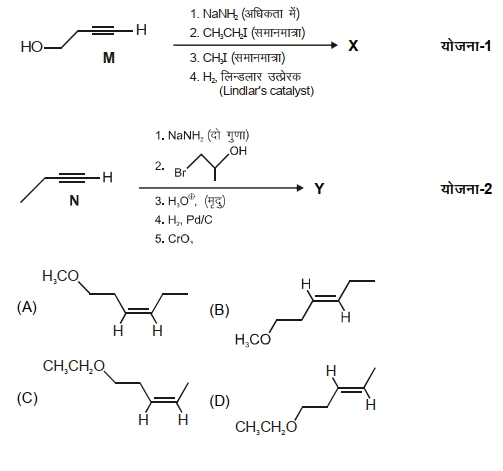
Schemes $1$ and $2$ describe sequential transformation of alkynes $M$ and $N$. Consider only the major products formed in each step for both the schemes. $Image$

$1.$ The product $X$ is

mcq $Image$

$2.$ The correct statement with respect to product $Y$ is :

$(A)$ It gives a positive Tollens test and is a functional isomer of $X$.

$(B)$ It gives a positive Tollens test and is a geometrical isomer of $X$.

$(C)$ It gives a positive iodoform test and is a functional isomer of $X$.

$(D)$ It gives a positive iodoform test and is a geometrical isomer of $X$.

Give the answer question $1$ and $2.$

The energy of an electron of $2p_y$ orbital is :
The electrodes of a conductivity cell are $3\,cm$ apart and have a cross-sectional area of $4\,c{m^2}$. The cell constant of the cell (in $c{m^{ - 1}}$) is
The most volatile compound is
Which of the following is correct expression for electrode potential of a cell
Osmotic pressure of a urea solution at ${10\,^o}C$ is $500\,\,mm.$ Osmotic pressure of the solution become $105.3 \,mm$. When it is diluted and temperature raised to ${25\,^o}C.$ The extent of dilution is .......... times