MCQ
Assertion : Anhydrous $BaO_2$ is used for preparing $H_2O_2$.

Reason : Hydrated $BaO_2$ is not available.

  • A
    If both Assertion and Reason are correct and the Reason is a correct explanation of the Assertion.
  • B
    If both Assertion and Reason are correct but Reason is not a correct explanation of the Assertion.
  • If the Assertion is correct but Reason is incorrect.
  • D
    If both the Assertion and Reason are incorrect.
Answer

Correct option: C.
If the Assertion is correct but Reason is incorrect.
c
Oxygen can form $2 \mathrm{p} \pi-2 \mathrm{p} \pi$ multiple bond with itself due to its small size while sulphur cannot form multiple bond with itself as $3 \mathrm{p} \pi-3 \mathrm{p} \pi$ bond will be unstable due to large size of sulphur, but sulphur can form multiple bond with small size atom like $\mathrm{C}$ and $\mathrm{N}$.

$\text { eg. } \mathrm{S}=\mathrm{C}=\mathrm{S}$

$\mathrm{S}=\mathrm{C}=\mathrm{N} \leftrightarrow \mathrm{S}^{\odot}-\mathrm{C} \equiv{N}$

Need a full question paper?

Generate a complete, print-ready paper with questions like this in minutes — across 16+ boards, with answer keys.

Start Generating Free

Similar questions

A solution containing $10\,g$ per $dm^3$ of urea (molecular mass $= 60\,g\,mol^{-1}$ ) is isotonic with a $5\%$ solution of a non volatile solute. The molecular mass of this non volatile solute is  ........ $g\,mol^{-1}$
The inversion of cane sugar is represented by${C_{12}}{H_{22}}{O_{11}} + {H_2}O \to {C_6}{H_{12}}{O_6} + {C_6}{H_{12}}{O_6}$ It is a reaction of
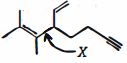
Bond $X$ is made by the overlap of which type of hybridized orbitals ?
The product(s) obtained via oxymercuration $(HgS{O_4} + {H_2}S{O_4})$ of  $ 1-$ butyne would be
In the following reaction $C{H_3} - C{H_2} - C{H_2} - C{H_3} \xrightarrow[475\, K]{H_2SO_4}$
Which of the following reacts with phenol to give salicylaldehyde after hydrolysis
Consider the cell at $25^{\circ} \mathrm{C}$

$\mathrm{Zn}\left|\mathrm{Zn}^{2+}(\mathrm{aq}),(1 \mathrm{M}) \| \mathrm{Fe}^{3+}(\mathrm{aq}), \mathrm{Fe}^{2+}(\mathrm{aq})\right| \mathrm{Pt}(\mathrm{s})$

The fraction of total iron present as $\mathrm{Fe}^{3+}$ ion at the cell potential of $1.500\, \mathrm{~V}$ is $\mathrm{X} \times 10^{-2}$. The value of $x$ is $.....$ (Nearest integer).

$\left(\right.$ Given $\left.E_{\mathrm{Fe}^{3+} / \mathrm{Fe}^{2+}}^{0}=0.77\, \mathrm{~V}, \mathrm{E}_{\mathrm{Zn}^{2+} / \mathrm{Zn}}^{0}=-0.76 \,\mathrm{~V}\right)$

Match List $I$ with List $II$ and select the correct answer using the codes given below the lists

 $\begin{array}{|l|l|} \hline \,\,List\,\,\,\,I\,\,(Compound) & \,\,List\,\,II\,\,(Oxidation\,\,state\,\,of\,\,N) \\ \hline (A)\,\,N{{O}_{2}} & (1)\,\,\,\,+\,\,5  \\ \hline (B)\,\,HNO  & (2)\,\,-\,\,3  \\ \hline (C)\,\,N{{H}_{3}} & (3)\,\,+\,\,4  \\ \hline (D)\,\,{{N}_{2}}{{O}_{5}} & (4)\,\,+\,\,1  \\ \hline \end{array}$

code :     $A \,\, B \,\,C \,\,D$      

Match List-$I$ with the List-$II$

List-$I$

Reaction

List-$II$

Type of redox reaction

$(A)$ $\mathrm{N}_{2(\mathrm{~g})}+\mathrm{O}_{2(\mathrm{~g})} \rightarrow 2 \mathrm{NO}_{(\mathrm{g})}$ $(I)$ Decomposition
$(B)$ $\begin{aligned} & 2 \mathrm{~Pb}\left(\mathrm{NO}_3\right)_{2(\mathrm{~s})} \rightarrow 2 \mathrm{PbO}_{(\mathrm{s})}+4 \mathrm{NO}_{2(\mathrm{~g})}+\mathrm{O}_{2(\mathrm{~g})}\end{aligned}$ $(II)$ Displacement
$(C)$ $\begin{aligned} 2 \mathrm{Na}_{(\mathrm{s})}+2 \mathrm{H}_2 \mathrm{O}_{(\mathrm{l})} \rightarrow 2 \mathrm{NaOH}_{(\mathrm{aq} .)}+\mathrm{H}_{2(\mathrm{~g})}\end{aligned}$ $(III)$ Disproportionation
$(D)$ $\begin{aligned} 2 \mathrm{NO}_{2(\mathrm{~g})}+2-\mathrm{OH}_{(\mathrm{aq})} \rightarrow \mathrm{NO}_{2(\mathrm{aq} .)}^{-}+\mathrm{NO}_{3(\mathrm{qq} .)}^{-}+\mathrm{H}_2 \mathrm{O}_{(\mathrm{l})}\end{aligned}$ $(IV)$ Combination

Choose the correct answer from the options given below:

Dumas method involves the determination of nitrogen content in the organic compound in the form of