MCQ
Assertion : Base in a transistor is made very thin as compared to collector and emitter regions.
Reason : Due to thin base power gain and voltage gain is obtained by a transistor.
  •  If both assertion and reason are true and the reason is the correct explanation of the assertion.
  • B
     If both assertion and reason are true but reason is not the correct explanation of the assertion.
  • C
    If assertion is true but reason is false.
  • D
     If the assertion and reason both are false.
Answer

Correct option: A.
 If both assertion and reason are true and the reason is the correct explanation of the assertion.
If both assertion and reason are true and the reason is the correct explanation of the assertion.

Need a full question paper?

Generate a complete, print-ready paper with questions like this in minutes — across 16+ boards, with answer keys.

Start Generating Free

Similar questions

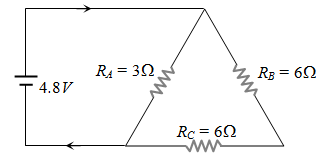
The current in the given circuit is

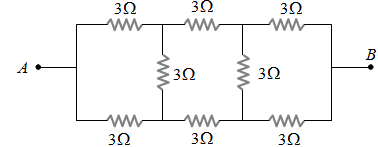
Calculate the equivalent resistance between A and B

A body is uniformly rotating about an axis fixed in an inertial frame of reference. Let $\overrightarrow{\text{A}}$ be a unit vector along the axis of rotation and $\overrightarrow{\text{B}}$ be the unit vector along the resultant force on a particle P of the body away from the axis. The value of $\overrightarrow{\text{A}}.\overrightarrow{\text{B}}$ is:
A copper ball of radius $1\, cm$ and work function $4.47\,eV$ is irradiated with ultraviolet radiation of wavelength $2500\mathop A\limits^o $. The effect of irradiation results in the emission of electrons from the ball. Further the ball will acquire charge and due to this there will be a finite value of the potential on the ball. The charge acquired by the ball is
An electron and a proton are moving on straight parallel paths with same velocity. They enter a semi-infinite region of uniform magnetic field perpendicular to the velocity. Which of the following statement$(s)$ is/are true?

$(A)$ They will never come out of the magnetic field region.

$(B)$ They will come out travelling along parallel paths.

$(C)$ They will come out at the same time.

$(D)$ They will come out at different times.

If half-life of a radioactive atom is $2.3\, days$, then its decay constant would be
The near point and far point of a person are $40\,cm$ and $250\,cm$ respectively. Determine the power of the lens he/she should use while reading a book kept at distance $25\,cm$ from the eye $..........D$
A symmetric double convex lens is cut in two equal parts by a plane perpendicular to the principal axis. If the power of the original lens was $4D,$ the power of a cutlens will be :
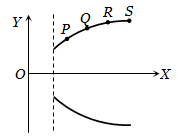
In a parabola spectrograph, the velocities of four positive ions P,Q,R and S are $v_1, v_2, v_3$ and $v_4$ respectively
Assertion : The surface charge densities of two spherical conductors of different radii are equal. Then the electric field intensities near their surface are also equal.
Reason : Surface charge density is equal to charge per unit area.