Question
Assertion : Binding energy (or mass defect) of hydrogen nucleus is zero.

Reason : Hydrogen nucleus contain only one nucleon.

Answer

The nucleus of hydrogen atom contains only one proton, and an orbital electron. There cannot be any nuclear binding energy in a hydrogen atom. Because nuclear binding can only arise when the nucleus contain at least two nucleons. Hydrogen atom contains only one nucleon.

Need a full question paper?

Generate a complete, print-ready paper with questions like this in minutes — across 16+ boards, with answer keys.
Start Generating Free

Similar questions

A liquid boils when its vapour pressure equals
An engine of a train, moving with uniform acceleration, passes the signal-post with velocity $u$ and the last compartment with velocity $v$. The velocity with which middle point of the train passes the signal post is
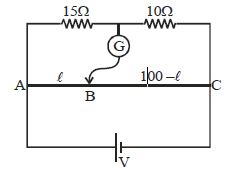
In the meter bridge shown, the length $AB$ for which the deflection in galvanometer is zero will be ............. $cm$
The extension in a string, obeying Hooke's law, is $x$. The speed of sound in the stretched string is $v$. If the extension in the string is increased to $1.5x$, the speed of sound will be
In a thin prism of glass (refractive index $1.5$), which of the following relations between the angle of minimum deviations ${\delta _m}$ and angle of refraction $r$ will be correct
A bubble in glass slab $(\mu = 1.5)$ when viewed from one side appears at $5\ cm$ and $2\ cm$ from other side, then thickness of slab is....$cm$
In a parallel plate capacitor the separation between the plates is $3\,mm$ with air between them. Now a $1\,mm$ thick layer of a material of dielectric constant $2$ is introduced between the plates due to which the capacity increases. In order to bring its capacity to the original value the separation between the plates must be made......$mm$
A diatomic molecule has how many degrees of freedom
Two parallel plate capacitor with different plate seperation but the same capacitance are connected in series to a battery. Both capacitors are filled with air. The quantity that is $NOT$ the same for both the capacitors when they are fully charged is
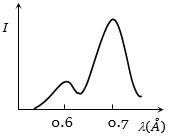
In the diagram a graph between the intensity of $X-$ rays emitted by a molybdenum target and the wavelength is shown, when electrons of $30\ keV$ are incident on the target. In the graph one peak is of ${K_\alpha }$ line and the other peak is of ${K_\beta }$ line