MCQ
Assertion : $CHCl_3$ is stored in dark bottles.
Reason : $CHCl_3$ is oxidised in dark.
  • A
    If both Assertion and Reason are correct and the Reason is a correct explanation of the Assertion.
  • B
    If both Assertion and Reason are correct but Reason is not a correct explanation of the Assertion.
  • If the Assertion is correct but Reason is incorrect.
  • D
    If both the Assertion and Reason are incorrect.

Answer

Correct option: C.
If the Assertion is correct but Reason is incorrect.
c
$CHCl_3$ is stored in dark bottles to prevent oxidation of $CHCl_3$ in presence of sunlight

Need a full question paper?

Generate a complete, print-ready paper with questions like this in minutes — across 16+ boards, with answer keys.

Start Generating Free

Similar questions

Given below are two statements:

Statement $I$ : The correct order of first ionization enthalpy values of $\mathrm{Li}, \mathrm{Na}, \mathrm{F}$ and $\mathrm{Cl}$ is $\mathrm{Na}<\mathrm{Li}<\mathrm{Cl}<\mathrm{F}$.

Statement $II$ : The correct order of negative electron gain enthalpy values of $\mathrm{Li}, \mathrm{Na}, \mathrm{F}$ and $\mathrm{Cl}$ is $\mathrm{Na}<\mathrm{Li}<\mathrm{F}<\mathrm{Cl}$

In the light of the above statements, choose the correct answer from the options given below :

Which of the following species is not electrophilic in nature
Equilibrium constants for the following reactions are given (pressure in atm) for the reactions at  $0\,^o C$. Select the option mentioning correct order of True $(T)$ or False $(F)$ statement

$A.6{H_2}{O_{\left( s \right)}} \rightleftharpoons A.2{H_2}{O_{(s)}} + \mathop {4{H_2}{O_{(g)}}};{{K_P} = 1.6 \times {{10}^{ - 11}}} $

$B.12{H_2}{O_{\left( s \right)}} \rightleftharpoons B.7{H_2}{O_{(s)}} + \mathop {5{H_2}{O_{(g)}}};{{K_P} = 2.43 \times {{10}^{ - 13}}} $

$B.10{H_2}{O_{\left( s \right)}} \rightleftharpoons {C_{(s)}} + \mathop {10{H_2}{O_{(g)}}};{{K_P} = {{10}^{ - 30}}} $

Aqueous tension of $H_2O$ at $0\,^oC$ is given as $0.76\  torr$

$(I)$ The most effective drying agent will be $C_{(s)}$. Out of $C_{(s)}$ , $B. 7H_2O_{(s)}$ & $A. 2H_2O_{(s)}$

$(II)$ At $0\,^oC$, $A.6H_2O_{(s)}$ & $B.12H_2O_{(s)}$ will

$(III)$ If $R.H$ is less than $100\%$ in a chamber at $0\,^oC$, then none of the substance can act as deliquescent

The optically active species among the following is
Product $(A)$ of the reaction is
The molar neutralization heat for $KOH$ and $HN{O_3}$ as compared to molar neutralization heat of $NaOH$ and $HCl$
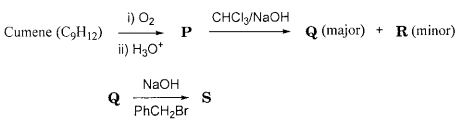
The correct statement($s$) about the following reaction sequence is(are)

(image)

($A$) $R$ is steam volatile

($B$) $Q$ gives dark violet coloration with $1 \%$ aqueous $FeCl_3$ solution

($C$) $S$ gives yellow precipitate with $2, 4$-dinitrophenylhydrazine

($D$) $S$ gives dark violet coloration with $1 \%$ aqueous $FeCl_3$ solution

Which one has asymmetric $C-$atom
If the solubility of a sparingly soluble salt of the type $B{A_2}$ (giving three ions on dissociation of a molecule) is $x$ moles per litre, then its solubility product is given by
Evaluate the following ratios for the energy of the electron in a particular orbit :

[Kinetic $:$ Potential ] and [Total $:$ Kinetic]