MCQ
Assertion : Coloured spectrum is seen when we look through a muslin cloth.

Reason : It is due to the diffraction of white light on passing through fine slits

  • both Assertion and Reason are correct and the Reason is a correct explanation of the Assertion.
  • B
    both Assertion and Reason are correct but Reason is not a correct explanation of the Assertion.
  • C
    the Assertion is correct but Reason is incorrect.
  • D
    both the Assertion and Reason are incorrect.
Answer

Correct option: A.
both Assertion and Reason are correct and the Reason is a correct explanation of the Assertion.
a
Porous muslin cloth has holes comparable to the wavelength of light falling on it. So, it get diffracted there forming fringes of different colours. We see it as colour spectrum.

Need a full question paper?

Generate a complete, print-ready paper with questions like this in minutes — across 16+ boards, with answer keys.

Start Generating Free

Similar questions

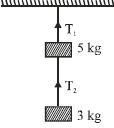
Two masses of $5\, kg$ and $3\, kg$ are suspended with the help of massless inextensible strings as shown in figure. The whole system is going upwards with an acceleration of $2\, ms^{-2}$. The tensions $T_1$ and $T_2$ are respectively (Take $g = 10\, ms^{-2}$)
Two plates are $2\,cm$ apart, a potential difference of $10\;volt$ is applied between them, the electric field between the plates is.........$N/C$
The deflection in moving coil galvanometer falls from $25$ divisions to $5$ division when a shunt of $24\  \Omega$ is applied. The resistance of galvanometer coil will be :
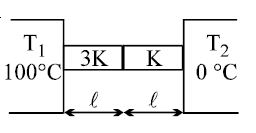
Two sheets of thickness $d$ and $3d$, are touching each other. The temperature just outside the thinner sheet side is $A$, and on the side of the thicker sheet is $C$. The interface temperature is $B. A, B$ and $C$ are in arithmetic progressing, the ratio of thermal conductivity of thinner sheet and thicker sheet is
A light rope is wound around a hollow cylinder of mass $5\,kg$ and radius $70\,cm$. The rope is pulled with a force of $52.5\,N$. The angular acceleration of the cylinder will be.....$ {rad \,s}{ }^{-2}$.
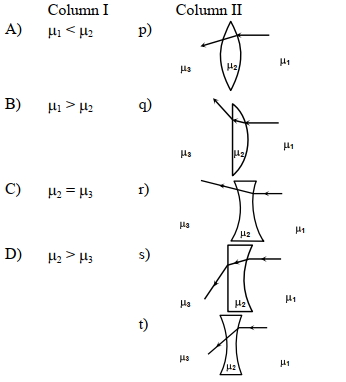
Two transparent media of refractive indices $\mu_1$ and $\mu_3$ have a solid lens shaped transparent material of refractive index $\mu_2$ between them as shown in figures in Column $II$. A ray traversing these media is also shown in the figures. In Column $I$ different relationships between $\mu_1, \mu_2$ and $\mu_3$ are given. Match them to the ray diagram shown in Column $II$.

$Image$

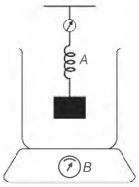
A spring balance $A$ reads $2 \,kg$ with a block of mass $m$ suspended from it. Another balance $B$ reads $3 \,kg$ when a beaker with a liquid is put on its pan. The two balances are now so arranged that the hanging mass $m$ is fully immersed inside the liquid in the beaker as shown in the figure given below.In this situation,
Two parallel plates separated by a distance of $5\,mm$ are kept at a potential difference of $50\,V.$ A particle of mass ${10^{ - 15}}\,kg$ and charge ${10^{ - 11}}\,C$ enters in it with a velocity ${10^7}\,m/s.$ The acceleration of the particle will be
The magnetism of magnet is due to
An iron needle slowly placed on the surface of water floats because