MCQ
Assertion: Critical angle is minimum for violet colour.

Reason : Because critical angle ${\theta _c} = {\sin ^{ - 1}}\,\left( {\frac{1}{\mu }} \right)$ and $\mu \, \propto \,\frac{1}{\lambda }$.

  • A
    If both Assertion and Reason are correct and the Reason is a correct explanation of the Assertion.
  • If both Assertion and Reason are correct but Reason is not a correct explanation of the Assertion.
  • C
    If the Assertion is correct but Reason is incorrect.
  • D
    If both the Assertion and Reason are incorrect.
Answer

Correct option: B.
If both Assertion and Reason are correct but Reason is not a correct explanation of the Assertion.
b
For total internal reflection to just take place, $\mu \sin \theta_c=1$

$\Rightarrow \theta_c=\sin ^{-1}\left(\frac{1}{\mu}\right)$

As a fact, the refractive index for a ray is inversely proportional to its wavelength. This is the reason for deviation of red light to be least in a prism.

Thus $\theta_c$ decreases with $\lambda$

Thus violet color has the least critical angle.

Need a full question paper?

Generate a complete, print-ready paper with questions like this in minutes — across 16+ boards, with answer keys.

Start Generating Free

Similar questions

An iron bar of length $L$ has magnetic moment $M$. It is bent at the middle of its length such that the two arms make an angle $60^{\circ}$ with each other. The magnetic moment of this new magnet is :
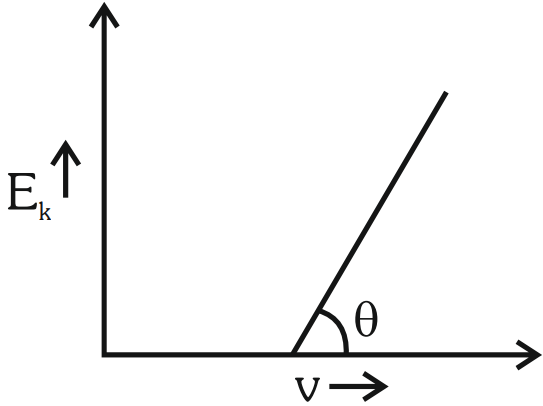
For the photoelectric effect, the maximum kinetic energy $\left(E_k\right)$ of the photoelectrons is plotted against the frequency $(v)$ of the incident photons as shown in figure. The slope of the graph gives

Image
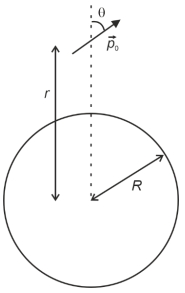
A small electric dipole $\vec{p}_0$, having a moment of inertia I about its center, is kept at a distance $r$ from the center of a spherical shell of radius $R$. The surface charge density $\sigma$ is uniformly distributed on the spherical shell. The dipole is initially oriented at a small angle $\theta$ as shown in the figure. While staying at a distance $r$, the dipole is free to rotate about its center.

If released from rest, then which of the following statement($s$) is (are) correct? [ $\varepsilon_0$ is the permittivity of free space.]

$(A)$ The dipole will undergo small oscillations at any finite value of $r$.

$(B)$ The dipole will undergo small oscillations at any finite value of $r>R$.

$(C)$ The dipole will undergo small oscillations with an angular frequency of $\sqrt{\frac{2 \sigma p_0}{\epsilon_0 I}}$ at $r=2 R$

$(D)$ The dipole will undergo small oscillations with an angular frequency of $\sqrt{\frac{\sigma p_0}{100 \epsilon_0 l}}$ at $r=10 R$

The current density in a cylindrical wire of radius $r=4.0 \,mm$ is $1.0 \times 10^{6} \,A / m ^{2}$. The current through the outer portion of the wire between radial distances $r / 2$ and $r$ is $x \pi A$; where $x$ is ..........
A tuning fork of unknown frequency produoes $4$ beats per second when sounded with another tuning fork of frequency $254 \,Hz$. It gives the same number of beats per second when unknown tuning fork loaded with wax. The unknown frequency before loading with wax is ..........
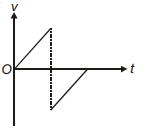
The velocity $(v)$-time $(t)$ graph for a particle moving along $x$-axis is shown in the figure. The corresponding position $(x)$ - time $(t)$ is best represented by
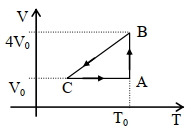
One mole of an ideal gas in initial state $\mathrm{A}$ undergoes a cyclic process $A B C A$, as shown in the figure. Its pressure at $A$ is $\mathrm{P}_0$. Choose the correct option$(s)$ from the following

$(A)$ Internal energies at $\mathrm{A}$ and $\mathrm{B}$ are the same

$(B)$ Work done by the gas in process $\mathrm{AB}$ is $\mathrm{P}_0 \mathrm{~V}_0 \ln 4$

$(C)$ Pressure at $C$ is $\frac{P_0}{4}$

$(D)$ Temperature at $\mathrm{C}$ is $\frac{\mathrm{T}_0}{4}$

A potential barrier of $ 0.50 $ $V $ exists across a $P-N$ junction. If the depletion region is $5.0 \times {10^{ - 7}}$m wide, the intensity of the electric field in this region is
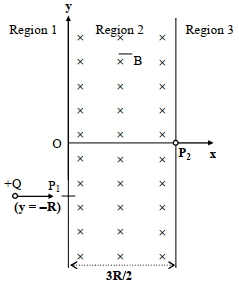
A uniform magnetic field $B$ exists in the region between $x=0$ and $x=\frac{3 R}{2}$ (region $2$ in the figure) pointing normally into the plane of the paper. A particle with charge $+Q$ and momentum $p$ directed along $x$-axis enters region $2$ from region $1$ at point $P_1(y=-R)$. Which of the following option(s) is/are correct?

$[A$ For $B>\frac{2}{3} \frac{p}{QR}$, the particle will re-enter region $1$

$[B]$ For $B=\frac{8}{13} \frac{\mathrm{p}}{QR}$, the particle will enter region $3$ through the point $P_2$ on $\mathrm{x}$-axis

$[C]$ When the particle re-enters region 1 through the longest possible path in region $2$ , the magnitude of the change in its linear momentum between point $P_1$ and the farthest point from $y$-axis is $p / \sqrt{2}$

$[D]$ For a fixed $B$, particles of same charge $Q$ and same velocity $v$, the distance between the point $P_1$ and the point of re-entry into region $1$ is inversely proportional to the mass of the particle

One million electron volt $(1\,MeV)$ is equal to