MCQ
Assertion : Cyclotron is a device which is used to accelerate the positive ion.

Reason : Cyclotron frequency depends upon the velocity

  • A
    If both Assertion and Reason are correct and the Reason is a correct explanation of the Assertion.
  • B
    If both Assertion and Reason are correct but Reason is not a correct explanation of the Assertion.
  • If the Assertion is correct but Reason is incorrect.
  • D
    If both the Assertion and Reason are incorrect.
Answer

Correct option: C.
If the Assertion is correct but Reason is incorrect.
c
Cyclotron is used to accelerate charged partides. So Assertion is correct.

We know that time period of a particle

$\mathrm{T}=\frac{2 \pi \mathrm{r}}{\mathrm{v}_{0}} ; \frac{\mathrm{mv}_{0}^{2}}{\mathrm{r}}=\mathrm{Bqv}_{0} \Rightarrow \mathrm{v}_{0}=\frac{\mathrm{Bqr}}{\mathrm{m}}$

$\mathrm{T}=\frac{2 \pi \mathrm{r}}{\mathrm{Bqr}} \times \mathrm{m}=\frac{2 \pi}{\mathrm{Bq}} \mathrm{m}$

Frequency $=\frac{1}{\mathrm{T}}=\frac{\mathrm{Bq}}{2 \pi \mathrm{m}}$

This does not dpeend upon velocity so Reason is incorrect.

Need a full question paper?

Generate a complete, print-ready paper with questions like this in minutes — across 16+ boards, with answer keys.

Start Generating Free

Similar questions

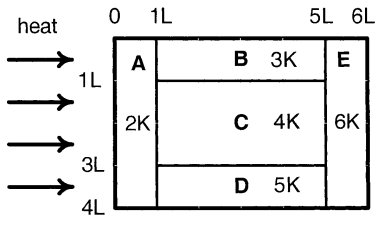
A composite block is made of slabs $A, B, C, D$ and $E$ of different thermal conductivities (given in terms of a constant $K$ ) and sizes (given in terms of length, $L$ ) as shown in the figure. All slabs are of same width. Heat $'Q'$ flows only from left to right through the blocks. Then in steady state $Image$

$(A)$ heat flow through $A$ and $E$ slabs are same.

$(B)$ heat flow through slab $E$ is maximum.

$(C)$ temperature difference across slab $E$ is smallest.

$(D)$ heat flow through $C =$ heat flow through $B +$ heat flow through $D$.

A train is moving with a constant speed along a large circular track. The engine of the train emits a sound of frequency $f$ . The frequency heard by the guard at rear end of the train
If the refractive indices of a prism for red, yellow and violet colours be $1.61, 1.63$ and $1.65$ respectively, then the dispersive power of the prism will be
A particle is projected vertically upwards with a speed of $16\  m/s$ , after some time , when it again passes through the point of projection, its speed is found to be $8\  m/s$ . It is known that the work done by air resistance is same during upward and downward motion. Then the maximum height attained by the particle is ...................... $\mathrm{m}$ ( $g$ = $10\  m/s^2$ )
The separation between the plates of a isolated charged parallel plate capacitor is increased. Which of the following quantities will change?
A force $\overrightarrow {F\,} = 6\hat i + 2\hat j - 3\hat k$ acts on a particle and produces a displacement of $\overrightarrow {s\,} = 2\hat i - 3\hat j + x\hat k.$ If the work done is zero, the value of $x$ is
Radiation from a black body at the thermodynamic temperature $T_1$ is measured by a small detector at distance $d_1$ from it. When the temperature is increased to $T_2$ and the distance to $d_2$ , the power received by the detector is unchanged . What is the ratio $d_2/d_1$ ?
The resistance $R =\frac{ V }{ I },$ where $V =(50 \pm 2) \;V$ and $I=(20 \pm 0.2)\;A.$ The percentage error in $R$ is $x\%$. The value of $x$ to the nearest integer is .........
$A$ spring block system is placed on a rough horizontal floor. The block is pulled towards right to give spring an elongation less than $\frac{{2\mu mg}}{K}$ but more than $\frac{{\mu mg}}{K}$ and released.The correct statement is
Which of the following processes is reversible