MCQ
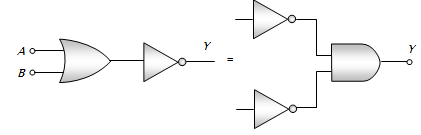
Assertion  : De$-$morgan's theorem $\overline{A+B}=\bar{A} \cdot \bar{B}$  may be explained by the following circuit
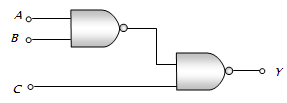
Reason  :  In the following circuit, for output inputs $\text{ABC}$ are $101$
  • A
    If both assertion and reason are true and the reason is the correct explanation of the assertion.
  • B
    If both assertion and reason are true but reason is not the correct explanation of the assertion.
  • If assertion is true but reason is false.
  • D
    If the assertion and reason both are false.
Answer

Correct option: C.
If assertion is true but reason is false.

Need a full question paper?

Generate a complete, print-ready paper with questions like this in minutes — across 16+ boards, with answer keys.

Start Generating Free

Similar questions

Identify the factor on which the capacitance of a parallel plate capacitor does not depend.
In a P-type semi-conductor, germanium is dopped with(a) Gallium (b) Boron(c) Aluminium(d) All of these
       
Two current carrying loops of same area but of different materials have same current flowing in them in anti-clockwise direction. if a magnetic field is applied in upward direction then potential energy of loop 1 and loop 2 will always be:
Assertion  :   Circuit containing capacitors should be handled cautiously even when there is no current.
Reason      : The capacitors are very delicate and so quickly break down.(a) If both assertion and reason are true and the reason is the correct explanation of the assertion.(b) If both assertion and reason are true but reason is not the correct explanation of the assertion.(c) If assertion is true but reason is false.(d) If the assertion and reason both are false.


When a loop moves towards a stationary magnet with speed v, the induced emf in the loop is E. If the magnet also moves away from the loop with the same speed, then the emf induced in the loop is.
Three observers $A, B$ and $C$ measure the speed of light coming from a source to be $vA, 0B$ and $vc.$ The observer $A$ moves towards the source and $C$ moves away from the source at the same speed. The observer $B$ stays stationary. The surrounding space is vacuum everywhere.
Compton effect is associated with (a) α -  rays(b) β -  rays(c) X-rays(d) Positive rays
       
In figure, there is a conducting ring having resistance $R$ placed in the plane of paper in a uniform magnetic field $B_0​$. If the ring is rotating in the plane of paper about an axis passing through point $O$ and perpendicular to the plane of paper with constant angular speed $\omega$ in clockwise direction, then.
Image
A parallel monochromatic beam of light is incident normally on a narrow slit. A diffraction pattern is formed on a screen placed perpendicular to the direction of incident beam. At the first maximum of the diffraction pattern the phase difference between the rays coming from the edges of the slit is 
Two points A and B are situated at a distance x and 2x respectively from the nearer pole of a magnet 2cm long. The ratio of magnetic field at A and B is: