MCQ
Assertion : Diamond glitters brilliantly.
Reason : Diamond does not absorb sunlight.
  • A
    If both assertion and reason are true and the reason is the correct explanation of the assertion.
  •  If both assertion and reason are true but reason is not the correct explanation of the assertion.
  • C
    If assertion is true but reason is false.
  • D
     If the assertion and reason both are false.

Answer

Correct option: B.
 If both assertion and reason are true but reason is not the correct explanation of the assertion.
If both assertion and reason are true but reason is not the correct explanation of the assertion.

Need a full question paper?

Generate a complete, print-ready paper with questions like this in minutes — across 16+ boards, with answer keys.

Start Generating Free

Similar questions

If a current of $3.0$ $amperes$ flowing in the primary coil is reduced to zero in $0.001$ $second,$ then the induced $e.m.f$ in the secondary coil is $15000$ $volts$. The mutual inductance between the two coils is....$henry$
A potential difference is applied across the ends of a metallic wire. If the potential difference is doubled, then the drift velocity
Which of the following isotopes is used for the treatment of cancer
Two wires $A$ and $B$ of the same material, having radii in the ratio $1: 2$ carry currents in the ratio $4: 1$. The ratio of drift speed of electrons in $A$ and $B$ is
A photon of energy $3.4 eV$ is incident on a metal having work function $2 eV$. The maximum $K.E$. of photo-electrons is equal to ........... $eV$
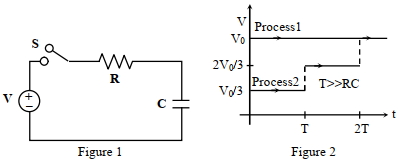
Consider a simple $RC$ circuit as shown in Figure $1$.

Process $1$: In the circuit the switch $S$ is closed at $t=0$ and the capacitor is fully charged to voltage $V_0$ (i.e. charging continues for time $T \gg R C$ ). In the process some dissipation ( $E_D$ ) occurs across the resistance $R$. The amount of energy finally stored in the fully charged capacitor is $EC$.

Process $2$: In a different process the voltage is first set to $\frac{V_0}{3}$ and maintained for a charging time $T \gg R C$. Then the voltage is raised to $\frac{2 \mathrm{~V}_0}{3}$ without discharging the capacitor and again maintained for time $\mathrm{T} \gg \mathrm{RC}$. The process is repeated one more time by raising the voltage to $V_0$ and the capacitor is charged to the same final

take $\mathrm{V}_0$ as voltage

These two processes are depicted in Figure $2$.

 ($1$) In Process $1$, the energy stored in the capacitor $E_C$ and heat dissipated across resistance $E_D$ are released by:

$[A]$ $E_C=E_D$ $[B]$ $E_C=E_D \ln 2$ $[C]$ $\mathrm{E}_{\mathrm{C}}=\frac{1}{2} \mathrm{E}_{\mathrm{D}}$ $[D]$ $E_C=2 E_D$

 ($2$) In Process $2$, total energy dissipated across the resistance $E_D$ is:

$[A]$ $\mathrm{E}_{\mathrm{D}}=\frac{1}{2} \mathrm{CV}_0^2$     $[B]$ $\mathrm{E}_{\mathrm{D}}=3\left(\frac{1}{2} \mathrm{CV}_0^2\right)$    $[C]$ $\mathrm{E}_{\mathrm{D}}=\frac{1}{3}\left(\frac{1}{2} \mathrm{CV}_0^2\right)$   $[D]$ $\mathrm{E}_{\mathrm{D}}=3 \mathrm{CV}_0^2$

Given the answer quetion  ($1$) and  ($2$)
The amplification factor of a triode valve is $15$. If the grid voltage is changed by $0.3 \,volt$  the change in plate voltage in order to keep the plate current constant (in volt) is
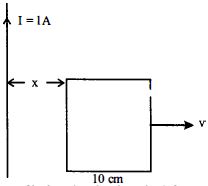
A square frame of side $10\, cm$ and a long straight wire carrying current $1\, A$ are in the plate of the paper. Starting from close to the wire, the frame moves towards the right with a constant speed of $10\, ms^{-1}$ (see figure). The $e.m. f$ induced at the time the left arm of the frame is at $x\, = 10\, cm$ from the wire is .....$\mu V$
Using the expression $2 d \sin \theta=\lambda$, one calculates the values of $d$ by measuring the corresponding angles $\theta$ in the range $0$ to $90^{\circ}$. The wavelength $\lambda$ is exactly knowns and the error in $\theta$ is constant for all values of $\theta$. As $\theta$ increases from $0^{\circ}$ :
A charged particle is whirled in a horizontal circle on a frictionless table by attaching it to a string fixed at one point. If a magnetic field is switched on in the vertical direction the tension in the string.