Question
Assertion : Electric potential and electric potential energy are different quantities.

Reason : For a system of positive test charge and point charge electric potential energy $=$ electric potential.

Answer

Potential and potential energy are different quantities and cannot be equated.

Need a full question paper?

Generate a complete, print-ready paper with questions like this in minutes — across 16+ boards, with answer keys.
Start Generating Free

Similar questions

body radiates energy $5W$ at a temperature of ${127^o}C$. If the temperature is increased to ${927^o}C$, then it radiates energy at the rate of ...... $W$
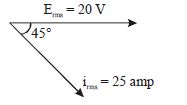
The vector diagram of current and voltage for a circuit is as shown. The components of the circuit will be
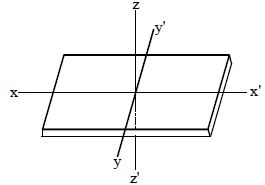
The rectangular plate shown in the figure is rotated in turn about $x-x,\, y-y$ and $z-z$ axes passing through its centre of mass $O$ . Its moment of inertia is
A sample of an ideal gas undergoes an isothermal expansion. If $d Q, d U$ and $d W$ represent the amount of heat supplied, the change in internal energy and the work done respectively, then
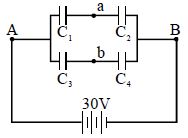
Four capacitors with capacitances $C_1 = 1\,\mu F, C_2 = 1.5\,\mu F, C_3 = 2.5\,\mu F$ and $C_4 = 0.5\,\mu F$ are connected as shown and are connected to a $30\, volt$ source. The potential difference between points $a$ and $b$ is.....$V$
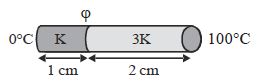
Two bars of thermal conductivities $K$ and $3K$ and lengths $1\,\, cm$ and $2\,\, cm$ respectively have equal cross-sectional area, they are joined lengths wise as shown in the figure. If the temperature at the ends of this composite bar is $0\,^oC$ and $100\,^oC$ respectively (see figure), then the temperature $\varphi $ of the interface is......... $^oC$
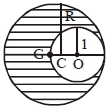
As shown in figure, when a spherical cavity (centred at $\mathrm{O})$ of radius $1$ is cut out of a uniform sphere of radius $\mathrm{R} \text { (centred at } \mathrm{C}),$ the centre of mass of remaining (shaded) part of sphere is at $G$, i.e, on the surface of the cavity. $\mathrm{R}$ can be detemined by the equation
The magnitude of a given vector with end points $ (4, -4, 0)$ and $(-2, -2, 0)$ must be
The probability of electrons to be found in the conduction band of an intrinsic semiconductor at a finite temperature
A body of mass $M$ hits normally a rigid wall with velocity $V$ and bounces back with the same velocity. The impulse experienced by the body is