Question

Assertion : In a common emitter transistor amplifier the input current is much less than the output current.

Reason     : The common emitter transistor amplifier has very high input impedance.

(a) If both assertion and reason are true and the reason is the correct explanation of the assertion.

(b) If both assertion and reason are true but reason is not the correct explanation of the assertion.

(c) If assertion is true but reason is false.

(d) If the assertion and reason both are false.

Answer

(c) If assertion is true but reason is false.

Need a full question paper?

Generate a complete, print-ready paper with questions like this in minutes — across 16+ boards, with answer keys.

Start Generating Free

Similar questions

Why was Rutherford’s atomic model unstable?
Of the following properties, the photon does not possess:

Resistance of a voltameter is 2, it is connected in series to a battery of 10 V through a resistance of 3. In a certain time mass deposited on cathode is 1 gm. Now the voltameter and the 3 resistance are connected in parallel with the battery. Increase in the deposited mass on cathode in the same time will be

(a) 0 

(b) 1.5 gm

(c) 2.5 gm

(d) 2 gm

Two bulbs of 100 W and 200 W working at 220 volt are joined in series with 220 volt supply. Total power consumed will be approximately.

(a) 65 watt

(b) 33 watt

(c) 300 watt

(d) 100 watt

A torch bulb rated as 4.5 W, 1.5 V is connected as shown in the figure. The e.m.f. of the cell needed to make the bulb glow at full intensity is

(a) 4.5 V

(b) 1.5 V

(c) 2.67 V

(d) 13.5 V

A galvanometer having a resistance of 8 ohm is shunted by a wire of resistance 2 ohm. If the total current is 1 amp, the part of it passing through the shunt will be

(a) 0.25 amp

(b) 0.8 amp

(c) 0.2 amp

(d) 0.5 amp

In a series RLC circuit that is operating above the resonant frequency, the current.
LCD stands for:
In a semiconductor, which of the following statement is correct?
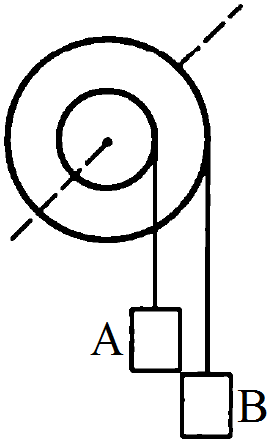
Figure shows a small wheel fixed coaxially on a bigger one of double the radius. The system rotates about the common axis. The strings supporting A and B do not slip on the wheels. If x and y be the distance travelled by A and B in the same time interval, then:

  1. x = 2y
  2. x = y
  3. y = 2x
  4. None of these.