MCQ
Assertion : In a transition the base is made thin.
Reason : A thin base makes the transistor stable.
  • A
    If both Assertion and Reason are correct and the Reason is a correct explanation of the Assertion.
  • B
    If both Assertion and Reason are correct but Reason is not a correct explanation of the Assertion.
  • If the Assertion is correct but Reason is incorrect.
  • D
    If both the Assertion and Reason are incorrect.
Answer

Correct option: C.
If the Assertion is correct but Reason is incorrect.
c
In a transistor the base is made thin so that base current remains small and we can get output or collector current. We know that

${I_c} = {I_e} - {I_b}$

Reason is incorrect

Need a full question paper?

Generate a complete, print-ready paper with questions like this in minutes — across 16+ boards, with answer keys.

Start Generating Free

Similar questions

Muon $(\mu ^{-1})$ is negatively charged $\left( {\left| q \right| = \left| e \right|} \right)$ with a mass $m_{\mu}\, = 200\,m_e$, where $m_e$ is the mass of the electron and $e$ is the electronic charge. If $\mu ^{-1}$ is bound to a proton to form a hydrogen like atom, identify the correct statements

$(A)$ Radius of the muonic orbit is $200$ times smaller than that of the electron

$(B)$ the speed of the $\mu ^{-1}$ in the $n^{th}$ orbit is $\frac{1}{{200}}$ times that of the election in the $n^{th}$ orbit

$(C)$ The Ionization energy of muonic atom is $200$ times more than that of an hydrogen atom

$(D)$ The momentum of the muon in the $n^{th}$ orbit is $200$ times more than that of the electron

Two positively charged spheres of masses $m_1$ and $m_2$ are suspended from a common point at the ceiling by identical insulating massless strings of length $l$. Charges on the two spheres are $q_1$ and $q_2$, respectively. At equilibrium, both strings make the same angle $\theta$ with the vertical. Then
A tank containing a liquid has turns of wire wrapped around it, causing it to act as an inductor. The liquid content of the tank can be measured by using its inductance to determine the height of the liquid level in the tank. The inductance of the tank changes from a value of $L_0$ corresponding to a relative permeability of $1$ when the tank is empty to value $L_f$ corresponding to a relative permeability $X_m$ (relative permeability of liquid) when the tank is full. The appropriate electronic circuit can determine the inductance correct upto $5$ significant figures and thus the effective relative permeability of the combined air and liquid within the rectangular has height $D$. The height of the liquid level in the tank is d . Ignore the fringing effects. Assume tank is fitted with $H _{ g } X _{ Hg }=2.9 \times 10^5$. Express d as a function of $L$, inductance corresponding to a certain liquid height $LO,Lf$ and $D$.
An electric dipole placed in a uniform elecrtric field exepriences:
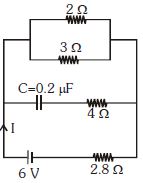
In the given figure the steady state current $I$ is ................. $\mathrm{A}$
One brass plate is inserted between two charges. The force between two charges will:
A ray of light is incident at an angle of 60° on one face of a prism of angle 30°. The ray emerging out of the prism makes an angle of 30° with the incident ray. The emergent ray is
A particle of charge $Q$ and mass $M$ moves in a circular path of radius $R$ in a uniform magnetic field of magnitude $B$. The same particle now moves with the same speed in a circular path of same radius $R$ in the space between the cylindrical electrodes of the cylindrical capacitor. The radius of the inner electrode is $R/2$ while that of the outer electrode is $ 3R/2.$ Then the potential difference between the capacitor electrodes must be
A circular loop of radius $R$ carries a current $I$. Another circular loop of radius $r(< < R) $ carries a current $i$ and is placed at the centre of the larger loop. The planes of the two circles are at right angle to each other. Find the torque acting on the smaller loop. 
When a conducting wire $X Y$ is moved towards the right, a current flows in the anti-clockwise direction. Direction of magnetic field at point $O$ is