Question

Assertion :   In meter bridge experiment, a high resistance is always connected in series with a galvanometer.

Reason     : As resistance increases current through the circuit increases.

(a) If both assertion and reason are true and the reason is the correct explanation of the assertion.

(b) If both assertion and reason are true but reason is not the correct explanation of the assertion.

(c) If assertion is true but reason is false.

(d) If the assertion and reason both are false.

Answer

(c) If assertion is true but reason is false.

Need a full question paper?

Generate a complete, print-ready paper with questions like this in minutes — across 16+ boards, with answer keys.

Start Generating Free

Similar questions

Particles which can be added to the nucleus of an atom without changing its chemical properties are called:

Two capacitors of 1mF  and 2mF  are connected in series, the resultant capacitance will be

(a) 4μF

(b)  

(c)  

(d) 3 μF

In a circuit of resistance $R$, magnetic flux $\Delta \phi$ changes in time $\Delta t$. Total charge $Q$ flowing through the circuit in time $\Delta r$ is :

A 36 W galvanometer is shunted by resistance of 4W. The percentage of the total current, which passes through the galvanometer is

(a) 8 %

(b) 9 %

(c) 10 %

(d) 91 %

An open organ pipe of length L vibrates in its fundamental mode. The pressure variation is maximum.
  1. At the two ends.
  2. At the middle of the pipe.
  3. At distances $\frac{\text{L}}{4}$ inside the ends.
  4. At distances $\frac{\text{L}}{8}$ inside the ends.
Magnitude of produced magnetic field at any point inside a solenoid depends on:
If a positive charge is shifted from a low-potential region to a high-potential region, the electric potential energy.
  1. Increases.
  2. Decreases.
  3. Remains the same.
  4. May increase or decrease.
When ultraviolet rays fall on the surface of metal, photoelectric effect does not occur but the following will casue :

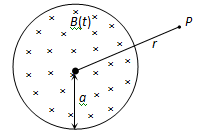
A uniform but time-varying magnetic field B(t) exists in a circular region of radius a and is directed into the plane of the paper, as shown. The magnitude of the induced electric field at point P at a distance r from the centre of the circular region

(a) Is zero

(b) Decreases as  

(c) Increases as r

(d) Decreases as  

If the intensity of incident radiation in a photo-cell is increased, how does the stopping potential vary?