Question
Assertion  :  In Young’s experiment, the fringe width for dark fringes is different from that for white fringes.
Reason      : In Young’s double slit experiment the fringes are performed with a source of white light, then only black and bright fringes are observed.(a) If both assertion and reason are true and the reason is the correct explanation of the assertion.(b) If both assertion and reason are true but reason is not the correct explanation of the assertion.(c) If assertion is true but reason is false.(d) If the assertion and reason both are false.


Answer

(d) If the assertion and reason both are false.

Need a full question paper?

Generate a complete, print-ready paper with questions like this in minutes — across 16+ boards, with answer keys.

Start Generating Free

Similar questions

The accelerations of a particle as seen from two frames $S_1$ and $S_2$ have equal magnitude $4m/s^2.$
  1. The frames must be at rest with respect to each other.
  2. The frames may be moving with respect to each other but neither should be accelerated with respect to the other.
  3. The acceleration of $S_2$with respect to $S_1$ may either be zero or $8m/s^2.$
  4. The acceleration of $S_2$ with respect to $S_1$ may be anything between zero and $8m/s.$
Two charge + q  and  -q  are situated at a certain distance.  At the point exactly midway between them(a) Electric field and potential both are zero(b) Electric field is zero but potential is not zero(c) Electric field is not zero but potential is zero(d) Neither electric field nor potential is zero


A heater coil is cut into two parts of equal length and one of them is used in the heater. The ratio of the heat produced by this half coil to that by the original coil is(a) 2 : 1   (b) 1 : 2(c) 1 : 4    (d) 4 : 1
       
Two identical thin rings, each of radius a meter, are coaxially placed at a distance $R$ meter apart. If $Q_1$ coulomb and $Q_2$ coulomb are respectively the charges uniformly spread on the two rings, the work done in moving a charge $q$ coulomb from the centre of one ring to that of the other is:
Assertion :  For best contrast between maxima and minima in the interference pattern of Young’s double slit experiment, the intensity of light emerging out of the two slits should be equal.
Reason     : The intensity of interference pattern is proportional to square of amplitude.(a) If both assertion and reason are true and the reason is the correct explanation of the assertion.(b) If both assertion and reason are true but reason is not the correct explanation of the assertion.(c) If assertion is true but reason is false.(d) If the assertion and reason both are false.


Which of the following can be chosen to analogously represent the behavior of a particle?
An alternating current is given by $\text{i}=\text{i}_1\cos\omega\text{t}+\text{i}_2\sin\omega\text{t}.$ The rms current is given by:
  1. $\frac{\text{i}_1+\text{i}_2}{\sqrt{2}}$
  2. $\frac{|\text{i}_1+\text{i}_2|}{\sqrt{2}}$
  3. $\sqrt{\frac{\text{i}_1^2+\text{i}_2^2}{2}}$
  4. $\sqrt{\frac{\text{i}_1^2+\text{i}_2^2}{\sqrt{2}}}$
The equation $\text{y}=\text{A}\sin^2(\text{kx}-\omega\text{t})$ represents a wave motion with:
  1. Amplitude A, frequency $\frac{\omega}{2\pi}$
  2. Amplitude $\frac{\text{A}}{2},$ frequency $\frac{\omega}{\pi}$
  3. Amplitude 2A, frequency $\frac{\omega}{4\pi}$
  4. Does not represent a wave motion.
An  object of length 6 cm is placed on the principle axis of a concave mirror of focal length f at a distance of 4f. The length of the image will be(a) 2 cm  (b) 12 cm(c) 4 cm(d) 1.2 cm
       
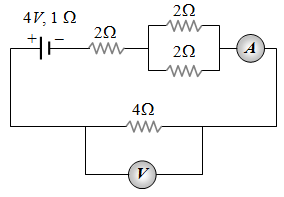
What is the equivalent resistance of the circuit