Question
Assertion :   Intensity of X-rays can be controlled by adjusting the filament current and voltage.
Reason     : The intensity of X-rays does not depend on number of X-ray photons emitted per second from the target.(a) If both assertion and reason are true and the reason is the correct explanation of the assertion.(b) If both assertion and reason are true but reason is not the correct explanation of the assertion.(c) If assertion is true but reason is false.(d) If the assertion and reason both are false.


Answer

(c) If assertion is true but reason is false.

Need a full question paper?

Generate a complete, print-ready paper with questions like this in minutes — across 16+ boards, with answer keys.

Start Generating Free

Similar questions

Assertion $: A$ current $I$ flows along the length of an infinitely long straight and thin walled pipe. Then the magnetic field at any point inside the pipe is zero.
Reason $: \oint \overrightarrow{\mathrm{B}} \cdot \mathrm{d} \overrightarrow{\mathrm{l}}=\mu_0 \mathrm{I}$
A hot liquid is kept in a big room. The logarithm of the numerical value of the temperature difference between the liquid and the room is plotted against time. The plot will be very nearly:
 The opposition offered by the electrolyte of the cell to the flow of current through itself is known as __________.
Number of electrons in the valence shell of a semiconductor is:
In Bohr's model of hydrogen atom, let PE represents potential energy and TE the total energy. In going to a higher level(a) PE decreases, TE increases(b) PE increases, TE increases(c) PE decreases, TE decreases(d) PE increases, TE decreases
   
   
If the binding energy per nucleon for $_3​Li^7$ is $5.6\ MeV,$ the total binding energy of a lithium nucleus is?
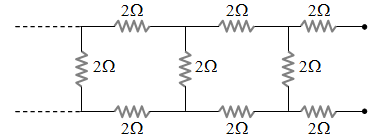
The equivalent resistance of the following infinite network of resistances is
No bias is applied to a P-N junction, then the current(a) Is zero because the number of charge carriers flowing on both sides is same(b) Is zero because the charge carriers do not move(c) Is non-zero(d) None of these


Coherent sources of light produce constructive interference while there is a phase difference between them is :
An electron passing through a potential difference of 4.9 V collides with a mercury atom and transfers it to the first excited state. What is the wavelength of a photon corresponding to the transition of the mercury atom to its normal state(a) 2050 Å(b) 2240 Å(c) 2525 Å(d) 2935 Å