Question

Assertion :   Moon is seen as it partly reflects the sun light falling on it

Reason     :  Moon is a satellite of earth. It does not emit light of its own

(a) If both assertion and reason are true and the reason is the correct explanation of the assertion.

(b) If both assertion and reason are true but reason is not the correct explanation of the assertion.

(c) If assertion is true but reason is false.

(d) If the assertion and reason both are false.

Answer

(a) If both assertion and reason are true and the reason is the correct explanation of the assertion.

Need a full question paper?

Generate a complete, print-ready paper with questions like this in minutes — across 16+ boards, with answer keys.

Start Generating Free

Similar questions

The capacity of a parallel plate capacitor with no dielectric substance but with a separation of 0.4 cm is  2 μF. The separation is reduced to half and it is filled with a dielectric substance of value 2.8. The final capacity of the capacitor is

(a) 11.2 μF

(b) 15.6 μF

(c) 19.2 μF

(d) 22. 4 μF

Assertion  : When PN-junction is forward biased then motion of charge carriers at junction is due to diffusion. In reverse biasing. The cause of motion of charge is drifting.

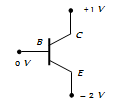
Reason     : In the following circuit emitter is reverse biased and collector is forward biased.

(a) If both assertion and reason are true and the reason is the correct explanation of the assertion.

(b) If both assertion and reason are true but reason is not the correct explanation of the assertion.

(c) If assertion is true but reason is false.

(d) If the assertion and reason both are false.

The focal length of a convex lens is 10 cm and its refractive index is 1.5.  If the radius of curvature of one surface is 7.5 cm, the radius of curvature of the second surface will be

(a) 7.5 cm

(b) 15.0 cm

(c) 75 cm

(d) 5.0 cm

An air capacitor is connected to a battery. The effect of filling the space between the plates with a dielectric is to increase

(a) The charge and the potential difference

(b) The potential difference and the electric field

(c) The electric field and the capacitance

(d) The charge and the capacitance

Plane polarised light is passed through a polaroid. On viewing through the polaroid we find that when the polariod is given one complete rotation about the direction of the light, one of the following is observed

(a) The intensity of light gradually decreases to zero and remains at zero

(b) The intensity of light gradually increases to a maximum and remains at maximum

(c) There is no change in intensity

(d) The intensity of light is twice maximum and twice zero

Magnetic moment of a small bar magnet is $1.2 A- m ^2$. Magnetisation field at a distance of 0.1 m on its axis is :
The equation of a light wave is written as $\text{y}=\text{A}\ \sin(\kappa\text{x}-\omega\text{t}).$ Here, y represents:
  1. Displacement of either particles.
  2. Pressure in the medium.
  3. Density of the medium.
  4. Electric field.
If the dipole with charges $\pm q$ are kept perpendicular to each other inside a closed cube, then the total electric flux emerging out of the cube will be:

There is no couple acting when two bar magnets are placed coaxially separated by a distance because

(a) There are no forces on the poles

(b) The forces are parallel and their lines of action do not coincide

(c) The forces are perpendicular to each other

(d) The forces act along the same line

The short range attractive nuclear forces that are responsible for the binding of nucleons in a nucleus are supposed to be caused by the role played by the particles called: