MCQ
$Assertion$ : $n$ small balls each of mass $m$ colliding elastically each second on surface with velocity $u$. The force experienced by the surface is $2\,mnu$.

$Reason$ : On elastic collision, the ball rebounds with the same velocity.

  • If both Assertion and Reason are correct and the Reason is a correct explanation of the Assertion.
  • B
    If both Assertion and Reason are correct but Reason is not a correct explanation of the Assertion.
  • C
    If the Assertion is correct but Reason is incorrect.
  • D
    If both the Assertion and Reason are incorrect.
Answer

Correct option: A.
If both Assertion and Reason are correct and the Reason is a correct explanation of the Assertion.
a
In elastic collision, kinetic energy remains conserved therefore the ball rebounds with the same velocity. According to Newton’s second law
$F \times t = $ change in linear momentum.
$\therefore F \times 1 = m \times n\left( {u + u} \right) \Rightarrow F = 2\,mmu$

Need a full question paper?

Generate a complete, print-ready paper with questions like this in minutes — across 16+ boards, with answer keys.

Start Generating Free

Similar questions

A positively charged particle moving along $x$-axis with a certain velocity enters a uniform electric field directed along positive $y$-axis. Its
If ${E_a}$ be the electric field strength of a short dipole at a point on its axial line and ${E_e}$ that on the equatorial line at the same distance, then
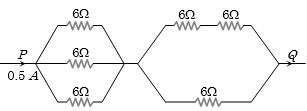
Resistances of $6\, ohm$ each are connected in the manner shown in adjoining figure. With the current $0.5\,ampere$ as shown in figure, the potential difference ${V_P} - {V_Q}$ is .............. $V$
If $2.2\, Kwatt$ power is transmitted through a $10\, ohm$ line at $22000\, volt$, the power loss in the form of heat will be ............. $watt$
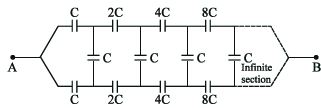
Find the equivalent capacitance of the circuit between point $A$ and $B$.
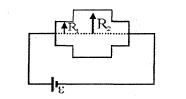
A cylindrical resistance is connected across battery $\varepsilon $ . Cylinder has uniform free electron density, mid part of cylinder has larger radius as shown in figure. Then $V_d$  (drift velocity) $V/S$ (distance across the length of the resistance)
A coil has an inductance of $0.7\,henry$ and is joined in series with a resistance of $220\,\Omega $. When the alternating $emf$ of $220\,V$ at $50\,Hz$ is applied to it then the phase through which current lags behind the applied $emf$ and the wattless component of current in the circuit will be respectively
A liquid at $30^{\circ} C$ is poured very slowly into a Calorimeter that is at temperature of $110^{\circ} C$. The boiling temperature of the liquid is $80^{\circ} C$. It is found that the first $5 gm$ of the liquid completely evaporates. After pouring another $80 gm$ of the liquid the equilibrium temperature is found to be $50^{\circ} C$. The ratio of the Latent heat of the liquid to its specific heat will be. . . . .${ }^{\circ} C$.  [Neglect the heat exchange with surrounding]
For the determination of refractive index of glass slab, a travelling microscope is used whose main scale contains 300 equal divisions equals to 15 cm . The vernier scale attached to the microscope has 25 divisions equals to 24 divisions of main scale. The least count (LC) of the travelling microscope is (in cm) :
If $\alpha $ and $\beta $ are the current gain the $CB$ and $CE$ configuration respectively of the transistor circuit then $\frac{{\left( {\beta  - \alpha } \right)}}{{\alpha \beta }} = $