MCQ
$Assertion$ : $n$ small balls each of mass $m$ colliding elastically each second on surface with velocity $u$. The force experienced by the surface is $2\,mnu$.

$Reason$ : On elastic collision, the ball rebounds with the same velocity.

  • If both Assertion and Reason are correct and the Reason is a correct explanation of the Assertion.
  • B
    If both Assertion and Reason are correct but Reason is not a correct explanation of the Assertion.
  • C
    If the Assertion is correct but Reason is incorrect.
  • D
    If both the Assertion and Reason are incorrect.
Answer

Correct option: A.
If both Assertion and Reason are correct and the Reason is a correct explanation of the Assertion.
a
In elastic collision, kinetic energy remains conserved therefore the ball rebounds with the same velocity. According to Newton’s second law
$F \times t = $ change in linear momentum.
$\therefore F \times 1 = m \times n\left( {u + u} \right) \Rightarrow F = 2\,mmu$

Need a full question paper?

Generate a complete, print-ready paper with questions like this in minutes — across 16+ boards, with answer keys.

Start Generating Free

Similar questions

Assume there are two identical simple pendulum Clocks$-1$ is placed on the earth and Clock$-2$ is placed on a space station located at a height $h$ above the earth surface. Clock$-1$ and Clock$-2$ operate at time periods $4\,s$ and $6\,s$ respectively. Then the value of $h$ is $....km$ (consider radius of earth $R _{ E }=6400\,km$ and $g$ on earth $10\,m / s ^{2}$ )
A soap bubble of radius $R$ and surface tension $T$ is formed in vacuum. It is slowly charged so that it slowly expands. It is stopped charging when the radius becomes $2R$ . Find the amount of charge given to the bubble.
Consider a long, straight wire of cross-sectional area A carrying a current i. Let there be n free electrons per unit volume. An observer places himself on a trolley moving in the direction opposite to the current with a speed $\text{v}=\frac{\text{i}}{\text{nAe}}$ and separated from the wire by a distance r. The magnetic field seen by the observer is very nearly:

  1. $\frac{\mu_0\text{i}}{2\pi\text{r}}$

  2. $\text{Zero}$

  3. $\frac{\mu_0\text{i}}{\pi\text{r}}$

  4. $\frac{2\mu_0\text{i}}{\pi\text{r}}.$

A car sounding a horn of frequency $ 1000 Hz$ passes an observer. The ratio of frequencies of the horn noted by the observer before and after passing of the car is $11 : 9$. If the speed of sound is v, the speed of the car is
Two soap bubbles coalesce to form a single bubble. If $V$ is the subsequent change in volume of contained air and $S$ change in total surface area, $T$ is the surface tension and $P$ atmospheric pressure, then which of the following relation is correct?
Two particles having masses $4\, g$ and $16\, g$ respectively are moving with equal kinetic energies. The ratio of the magnitudes of their linear momentum is $n : 2 .$ The value of $n$ will be ...... .
The following four wires are made of the same material. Which of these will have the largest extension when the same tension is applied?
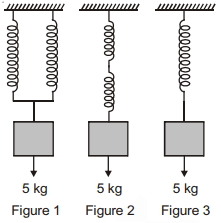
Two identical springs have the same force constant $73.5 \,Nm ^{-1}$. The elongation produced in each spring in three cases shown in Figure-$1$, Figure-$2$ and Figure-$3$ are $\left(g=9.8 \,ms ^{-2}\right)$
Two blocks of masses $5 \,kg$ and $2 \,kg$ are connected by a spring of negilible mass and placed on a frictionless horizontal surface. An impulse gives a velocity of $7 \,m / s$ to the heavier block in the direction of the lighter block. The velocity of the centre of mass is ....... $m / s$
The shear strain is possible in .............