MCQ
Assertion : No interference pattern is detected when two coherent sources are infinitely close to each other.

Reason : The fringe width is inversely proportional to the distance between the two slits.

  • If both Assertion and Reason are correct and the Reason is a correct explanation of the Assertion.
  • B
    If both Assertion and Reason are correct but Reason is not a correct explanation of the Assertion.
  • C
    If the Assertion is correct but Reason is incorrect.
  • D
    If both the Assertion and Reason are incorrect.
Answer

Correct option: A.
If both Assertion and Reason are correct and the Reason is a correct explanation of the Assertion.
a
When $d$ is negligibly small, fringe width $\beta $ which is proportional to $1/d$ may become too large. Even a single fringe may occupy the whole screen. Hence the pattern cannot be detected.

Need a full question paper?

Generate a complete, print-ready paper with questions like this in minutes — across 16+ boards, with answer keys.

Start Generating Free

Similar questions

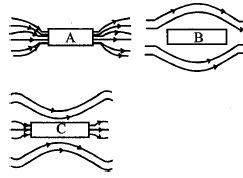
Three identical bars $A, B$ and $C$ are made of different magnetic materials. When kept in a uniform magnetic field, the field lines around them look as follows: Make the correspondence of these bars with their material being diamagnetic $(D)$, ferromagnetic $(F)$ and paramagnetic $(P)$
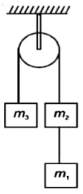
Three blocks of masses $m_1=4 \,kg , m_2=2 \,kg , m_3=4 \,kg$ are connected with ideal strings passing over a smooth. massless pulley as shown in figure. The acceleration of blocks will be ......... $m / s ^2$ $\left(g=10 \,m / s ^2\right)$
$A$ beam of light consisting of two wavelengths $6500Å$ and $5200Å$ is used to obtain interference fringes in Young’s double slit experiment. The distance between slits is $2\, mm$ and the distance of screen from slits is $120\, cm$. What is the least distance from central maximum where the bright due to both wavelength coincide?
Two rods of same material have same length and area. The heat $\Delta Q$ flows through them for $12\,minutes$ when they are jointed in series. If now both the rods are joined in parallel, then the same amount of heat $\Delta Q$ will flow in ........ $\min$
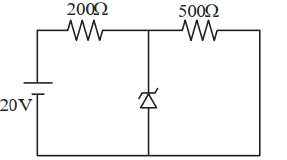
A Zener diode of breakdown voltage $10 \mathrm{~V}$ is used as a voltage regulator as shown in the figure. The current through the Zener diode is
An oil drop of $12$ excess electrons is held stationary under a constant electric field of $2.55 \times 10^{4}\; N\,C ^{-1}$ (Millikan's oil drop experiment). The density of the oil is $1.26 \;g \,cm ^{-3} .$ Estimate the radius of the drop. $\left(g=9.81\; m s ^{-2} ; e=1.60 \times 10^{-19}\; \,C \right)$
$Henry/ohm$ can be expressed in
In an electromagnetic wave, at an instant and at a particular position, the electric field is along the negative $z$-axis and magnetic field is along the positive $x$-axis. Then the direction of propagation of electromagnetic wave is
Five moles of helium are mixed with two moles of hydrogen to form a mixture. Take molar mass of helium $M_1=4\ g$ and that of hydrogen $M_2=2\ g$ The equivalent degree of freedom $f$ of the mixture is
Two identical mass $M$ moving with velocity $\mu_1$ and $\mu_2$ collide perfectly inelastically. The loss in energy is