Question

Assertion  :   On going away from a point charge or a small electric dipole, electric field decreases at the same rate in both the cases.

Reason      : Electric field is inversely proportional to square of distance from the charge or an electric dipole.

(a) If both assertion and reason are true and the reason is the correct explanation of the assertion.

(b) If both assertion and reason are true but reason is not the correct explanation of the assertion.

(c) If assertion is true but reason is false.

(d) If the assertion and reason both are false.

Answer

(d) If the assertion and reason both are false.

Need a full question paper?

Generate a complete, print-ready paper with questions like this in minutes — across 16+ boards, with answer keys.

Start Generating Free

Similar questions

Light from a tungsten filament lamp gives:

Eight small drops, each of radius r and having same charge q are combined to form a big drop. The ratio between the potentials of the bigger drop and the smaller drop is

(a) 8 : 1

(b) 4 : 1

(c) 2 : 1

(d) 1 : 8

Light of wavelength $\lambda$ falls on a metal having work function $\frac{\text{h}_\text{c}}{\lambda_0}.$ Photoelectric effect will take place only if:

  1. $\lambda\geq\lambda_0$

  2. $\lambda\geq2\lambda_0$

  3. $\lambda\leq\lambda_0$

  4. $\lambda<\frac{\lambda_ 0}{2}.$

There are two conductors X and Y carrying a current I and moving in the same direction. p and q are two electron beams also moving in the same direction. Will there be attraction or repulsion between the 2 conductors and between the two electron beams separately?

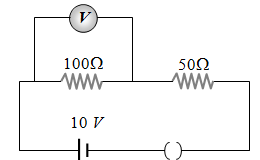
In the given circuit, the voltmeter records 5 volts. The resistance of the voltmeter in ohms is

(a) 200

(b) 100

(c) 10       

(d) 50

If heat is supplied to an ideal gas in an isothermal process:
  1. The internal energy of the gas will increase.
  2. The gas will do positive work.
  3. The gas will do negative work.
  4. The said process is not possible.

The potential drop across the 3W resistor is

(a) 1 V

(b) 1.5 V

(c) 2 V

(d) 3 V

The magnetic induction in the region between the pole faces of an electromagnet is 0.7 weber/m2. The induced e.m.f. in a straight conductor 10 cm long, perpendicular to B and moving perpendicular both to magnetic induction and its own length with a velocity 2 m/sec is

(a) 0.08 V

(b) 0.14 V

(c) 0.35 V  

(d) 0.07 V

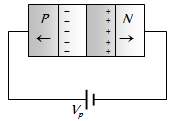
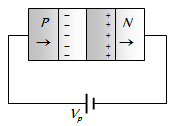
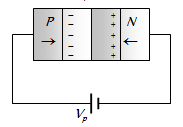
In the case of forward biasing of PN-junction, which one of the following figures correctly depicts the direction of flow of carriers

(a)

(b)

(c)

(d)

Which of the following option represents Amperemaxwell Law ?