Question
Assertion : Position of image approaches focus of a lens, only when object approaches infinity.

Reason : Paraxial rays incident parallel to principal axis intersect at the focus after refraction from lens.

Answer

Assertion is correct, Reason is correct.

Need a full question paper?

Generate a complete, print-ready paper with questions like this in minutes — across 16+ boards, with answer keys.

Start Generating Free

Similar questions

If $\hat i$ denotes a unit vector along incident light ray, $\hat r$ a unit vector along refracted ray into a medium of refractive index $\mu $ and $\hat n$ unit vector normal to boundary of medium directed towards incident medium, then law of refraction is
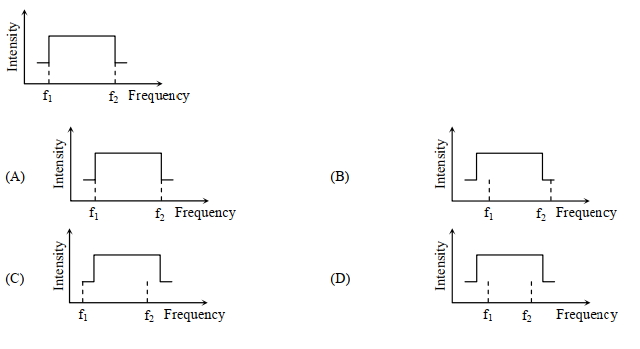
Two trains $A$ and $B$ are moving with speeds $20 \mathrm{~m} / \mathrm{s}$ and $30 \mathrm{~m} / \mathrm{s}$ respectively in the same direction on the same straight track, with $B$ ahead of $A$. The engines are at the front ends. The engine of train  $A$ blows a long whistle.

Assume that the sound of the whistle is composed of components varying in frequency from $f_1=800 \mathrm{~Hz}$ to $f_2=1120 \mathrm{~Hz}$, as shown in the figure. The spread in the frequency (highest frequency - lowest frequency) is thus $320 \mathrm{~Hz}$. The speed of sound in still air is $340 \mathrm{~m} / \mathrm{s}$.

$1.$  The speed of sound of the whistle is

$(A)$ $340 \mathrm{~m} / \mathrm{s}$ for passengers in $A$ and $310 \mathrm{~m} / \mathrm{s}$ for passengers in $B$

$(B)$ $360 \mathrm{~m} / \mathrm{s}$ for passengers in $A$ and $310 \mathrm{~m} / \mathrm{s}$ for passengers in $B$

$(C)$ $310 \mathrm{~m} / \mathrm{s}$ for passengers in $A$ and $360 \mathrm{~m} / \mathrm{s}$ for passengers in $B$

$(D)$ $340 \mathrm{~m} / \mathrm{s}$ for passengers in both the trains

$2.$  The distribution of the sound intensity of the whistle as observed by the passengers in train $\mathrm{A}$ is best represented by

$Image$

$3.$  The spread of frequency as observed by the passengers in train $B$ is

$(A)$ $310 \mathrm{~Hz}$ $(B)$ $330 \mathrm{~Hz}$ $(C)$ $350 \mathrm{~Hz}$ $(D)$ $290 \mathrm{~Hz}$

Give the answer question $1,2$ and $3.$
The ionisation potential of $H-$atom is $13.6\,V$. When it is excited from ground state by monochromatic radiations of $970.6\,{\mathring A}$, the number of emission lines will be (according to Bohr’s theory)
The radiation emitted by a star $A$ is $10,000$ times that of the sun. If the surface temperatures of the sun and the star $A$ are $6000 K$ and $2000 K$ respectively, the ratio of the radii of the star $A$ and the sun is
Internal energy of a non-ideal gas depends on ..........
If for two vectors $\overrightarrow A $ and $\overrightarrow B ,\overrightarrow A \times \overrightarrow B = 0,$ the vectors
Retina of eye acts like ........ of camera
Two satellites of earth $S_1$ and $S_2$ are moving in the same orbit. The mass of $S_1$ is four times the mass of $S_2$. Which one of the following statement is true ?
A $5\,^oC$ rise in temperature is observed in a conductor by passing a current. When the current is doubled the rise in temperature will be approximately ........... $^oC$
The speed of light in air is $3 \times {10^8}\,\,m/s$. What will be its speed in diamond whose refractive index is $2.4$