MCQ
Assertion : Potassium ferrocyanide is diamagnetic, whereas potassium ferricyanide is paramagnetic.

Reason : Crystal field splitting in ferrocyanide ion is greater than that of ferricyanide ion.

  • A
    If both Assertion and Reason are correct and the Reason is a correct explanation of the Assertion.
  • B
    If both Assertion and Reason are correct but Reason is not a correct explanation of the Assertion.
  • If the Assertion is correct but Reason is incorrect.
  • D
    If both the Assertion and Reason are incorrect.
Answer

Correct option: C.
If the Assertion is correct but Reason is incorrect.
c
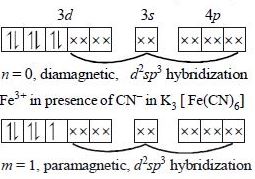
In potassium ferrocyanide, $Fe$ is in the form $Fe^{2+}$ and in potassium ferricyanide, $Fe$ is in the form $Fe^{3+}$.  $CN^-$ is a strong legand. so, it will pair up all the $3d^6$ electrons of $Fe^{3+}$ and make it diamagnetic. In $Fe^{2+}$ , all the $3d^5$ electrons are not paired up. One electron remains unpaired. So, it is paramagnetic. $Fe^{2+}$ in presence of $CN^-$ in $[K_4(Fe(CN)_6)]$.

However, the reson is false because crystal field splitting in ferrocyanide is less than in ferricyanide ion (higher the oxidation state of the metal, geater the crystal field splitting).

Need a full question paper?

Generate a complete, print-ready paper with questions like this in minutes — across 16+ boards, with answer keys.

Start Generating Free

Similar questions

Assertion : $[Co(NO_2)_3(NH_3)_3]$ does not show optical isomerism.

Reason : It has a plane of symmetry.

${C_2}{H_5}MgI$ reacts with $HCHO$ to form last product
The Henry's law constant for the solubility of $N_2$ gas in water at $298\,K$ is $1.0 \times 10^5\, atm$. The mole fraction of $N_2$ in air is $0.8$. The number of moles of $N_2$ from air dissolved in $10\,moles$ of water at $298\,K$ and $5\,atm$ pressure will be
Which of the following is expected to form colourless complex
Which of the following compound(s) will not dissolve in an alkali solution after it has undergone reaction with Hinsberg's reagent?
A reaction has a half life of $1\,min.$ The time required for $99.9\, \%$ completion of the reaction is ......... $min.$ (Round off to the Nearest integer)

[Use : $\ln\, 2=0.69, \ln \,10=2.3]$

$C{H_3} - C{H_2} - CH = O\xrightarrow[{(2)\,{H^ \oplus }}]{{(1)\,{\text{Tollen's reagent}}}}X$

$X\xrightarrow[{(2)\,\,drydistillation}]{{(1)\,Ca{{(OH)}_2}}}Y$

$Y$ is

The standard reduction electrode potentials of four elements are

$A = - 0.250\,V$   $B = - 0.136\,V$   $C = - 0.126\,V$     $D = - 0.402\,V$

The element that displaces $A$ from its compounds is

During the nuclear explosion, one of the products is $^{90}  \mathrm{Sr}$ with half life of $6.93$ years. if $1 \;\mu g$ of $^{90} \mathrm{Sr}$ was absorbed in the bones of a newly born baby in place of $Ca$, how much time, in years, is required to reduce it by $90 \%$ if it is not lost metabolically
$MeO$ The compound $(X)$ is