MCQ
Assertion : Potassium ferrocyanide is diamagnetic, whereas potassium ferricyanide is paramagnetic.

Reason : Crystal field splitting in ferrocyanide ion is greater than that of ferricyanide ion.

  • A
    If both Assertion and Reason are correct and the Reason is a correct explanation of the Assertion.
  • B
    If both Assertion and Reason are correct but Reason is not a correct explanation of the Assertion.
  • If the Assertion is correct but Reason is incorrect.
  • D
    If both the Assertion and Reason are incorrect.
Answer

Correct option: C.
If the Assertion is correct but Reason is incorrect.
c
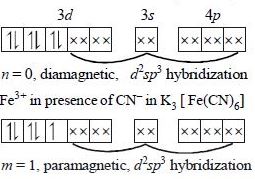
In potassium ferrocyanide, $Fe$ is in the form $Fe^{2+}$ and in potassium ferricyanide, $Fe$ is in the form $Fe^{3+}$.  $CN^-$ is a strong legand. so, it will pair up all the $3d^6$ electrons of $Fe^{3+}$ and make it diamagnetic. In $Fe^{2+}$ , all the $3d^5$ electrons are not paired up. One electron remains unpaired. So, it is paramagnetic. $Fe^{2+}$ in presence of $CN^-$ in $[K_4(Fe(CN)_6)]$.

However, the reson is false because crystal field splitting in ferrocyanide is less than in ferricyanide ion (higher the oxidation state of the metal, geater the crystal field splitting).

Need a full question paper?

Generate a complete, print-ready paper with questions like this in minutes — across 16+ boards, with answer keys.

Start Generating Free