MCQ
$Assertion$ : Radius of gyration of body is a constant quantity.
$Reason$ : The radius of gyration of a body about an axis of rotation may be defined as the root mean square distance of the particle from the axis of rotation
  • A
    If both Assertion and Reason are correct and the Reason is a correct explanation of the Assertion.
  • B
    If both Assertion and Reason are correct but Reason is not a correct explanation of the Assertion.
  • C
    If the Assertion is correct but Reason is incorrect.
  • If both the Assertion and Reason are incorrect.
Answer

Correct option: D.
If both the Assertion and Reason are incorrect.
d
Radius of gyration of body is not a constant quantity. Its value changes with the change in location of the axis of rotation. Radius of gyration of a body about a given axis is given as

$K = \sqrt {\frac{{r_1^2 + r_2^2 + ......r_n^2}}{n}} $

Need a full question paper?

Generate a complete, print-ready paper with questions like this in minutes — across 16+ boards, with answer keys.

Start Generating Free

Similar questions

A projectile is fired from level ground at an angle $\theta $ above the horizontal. The elevation angle $\phi $ of the highest point as seen from the launch point is related to $\theta $ by the relation
Force of gravity is least at
stationary source is emitting sound at a fixed frequency $f_0$, which is reflected by two cars approaching the source. The difference between the frequencies of sound reflected from the cars is $1.2\%$ of $f_0$. What is the difference in the speeds of the cars (in $km$ per hour) to the nearest integer ..... $km/hr$ ? The cars are moving at constant speeds much smaller than the speed of sound which is $330$ $ms^{-1}$.
The moment of inertia of a uniform thin rod about a perpendicular axis passing through one end is $I_{1}$. The same rod is bent into a ring and its moment of inertia about a diameter is $I _{2}$. If $\frac{ I _{1}}{ I _{2}}$ is $\frac{ x \pi^{2}}{3}$, then the value of $x$ will be ...............
A vehicle travels half the distance $L$ with speed $V_1$ and the other half with speed $V_2$, then its average speed is:
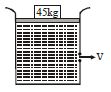
A large cylindrical tank of cross-sectional area $1\ m^2 $ is filled with water. It has a small hole at a height of $1\ m $ from the bottom. $A$ movable piston of mass $5$ $kg$ is fitted on the top of the tank such that it can slide in the tank freely without friction. A load of $45$ $kg$ is applied on the top of water by piston, as shown in figure. The value of $v$ when piston is $7$ $m$ above the bottom is $(g = 10\ m/s^2)$ ....... $m/s$
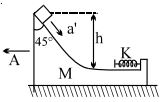
$A$ small block of mass $m$ is placed on $a$ wedge of mass $M$ as shown, which is initially at rest. All the surfaces are frictionless . The spring attached to the other end of wedge has force constant $k$. If $a'$ is the acceleration of $m$ relative to the wedge as it starts coming down and $A$ is the acceleration acquired by the wedge as the block starts coming down, then 
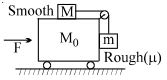
Imagine $a$ situation in which the horizontal surface of block $M_0$ is smooth and its vertical surface is rough with $a$ coefficient of friction $\mu$  Identify the correct statement $(s)$
A particle is doing simple harmonic motion of amplitude $0.06 \mathrm{~m}$ and time period $3.14 \mathrm{~s}$. The maximum velocity of the particle is. . . . .. . $\mathrm{cm} / \mathrm{s}$.
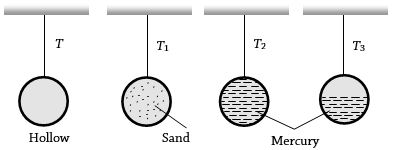
The period of a simple pendulum, whose bob is a hollow metallic sphere, is $T$.The period is $T_1$ when the bob is filled with sand, $T_2$ when it is filled with mercury and $T_3$ when it is half filled with mercury. Which of the following is true