MCQ
Assertion : Sigma $(\sigma )$ is a strong bond, while pi $(\pi )$ is a weak bond.
Reason : Atoms rotate freely about pi $(\pi )$ bond.
  • A
    If both Assertion and Reason are correct and the Reason is a correct explanation of the Assertion.
  • B
    If both Assertion and Reason are correct but Reason is not a correct explanation of the Assertion.
  • If the Assertion is correct but Reason is incorrect.
  • D
    If both the Assertion and Reason are incorrect.
Answer

Correct option: C.
If the Assertion is correct but Reason is incorrect.
c
Sigma $(\sigma )$ bond is formed by axial overlap of atomic orbitals while pi $(\pi )$ bond is formed by lateral overlap. Since axial overlapping takes place to a greater extent than the lateral overlapping, former $(\sigma )$ bond is stronger than pi bond. Atoms attached to doubly bonded atom can't rotate freely around the double bond.

Need a full question paper?

Generate a complete, print-ready paper with questions like this in minutes — across 16+ boards, with answer keys.

Start Generating Free

Similar questions

In $20\,\, ml \,\,0.4 \,M-HA$ solution, $80\,\, ml$ water is added. Assuming volume to be additive, the $pH$ of final solution is

$(K_a \,\,of\,\, HA = 4 \times 10^{-7} ,\, log\,2 = 0.3)$

The certain volume of a gas exerts on its walls some pressure at a particular temperature. It has been found that by reducing the volume of the gas to half of its original value the pressure becomes twice that of the initial value at a constant temperature. This happens because :
$pH + pOH$ equal to
Given below are two statements: one is labelled as Assertion $(A)$ and the other is labelled as Reason $(R)$.

Assertion $(A)$ : $\mathrm{NH}_3$ and $\mathrm{NF}_3$ molecule have pyramidal shape with a lone pair of electrons on nitrogen atom. The resultant dipole moment of $\mathrm{NH}_3$ is greater than that of $\mathrm{NF}_3$.

Reason $(R)$ : In $\mathrm{NH}_3$, the orbital dipole due to lone pair is in the same direction as the resultant dipole moment of the $\mathrm{N}-\mathrm{H}$ bonds. $\mathrm{F}$ is the most electronegative element.

In the light of the above statements, choose the correct answer from the options given below:

In which of following option is wrong about stability of diatomic molecules
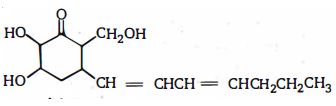
A naturally occurring substance has the constitution shown below. How many may  have this constitution ?
Assign $A, B, C, D$ from given type of reaction.

A for disproportionation reaction.

B for comproportionation reaction.

C for either intermolecular redox reaction or displacement reaction.

D for either thermal combination redox reaction or thermal decomposition redox reaction.

$MnO_4^ -  + {H^ + } + B{r^ - } \longrightarrow M{n^{2 + }}\left( {aq.} \right) + B{r_2} \uparrow $

Powder of beryllium burns in air frequently to produce:
Decreasing order of stability of following carbocations is 

$(A)$ $m-CH_3OPhCH_2^+$     $(B)$ $p-CH_3OPhCH_2^+$  $(C)$ $PhCH_2^+$               $(D)$ $p-NO_2PhCH_2^+$

The number of electron pairs in $\ce{XeF_4}$ at the corners of the square are $ .........$